
A mother came to me recently, still shaken by what had happened the week before.
Her 17-year-old son, a good student, a responsible kid, someone she trusted, had gone to a friend’s birthday party. The parents were home. It was supposed to be safe.
Except that the birthday boy’s older brother had smuggled in alcohol. And her son ~ her sensible, intelligent son, had not only drunk it but had been the one encouraging others to try it.
When she found out, she was devastated.
“I don’t understand,” she said. “He KNOWS better. We’ve talked about this. He’s seen what alcohol does ~ his own uncle struggled with it. He KNEW the consequences.”
She looked at me, searching for an answer.
“So why did he do it?”
· · ·
Here’s what haunts parents most about teenage risk-taking:
It’s not that teenagers don’t know the risks.
It’s that they know ~ and they do it anyway.
Your daughter knows that getting into a car with a reckless driver is dangerous. She gets in anyway.
Your son knows that cheating on an exam could destroy his academic record. He does it anyway.
Your teenager knows that posting that photo, sending that message, trying that substance, sneaking out that night ~ could all go badly wrong.
They know. And they still do it.
This is what makes parents feel helpless. If they didn’t know better, you could educate them. But they DO know better. So what’s left?
Here’s the answer ~ and it might surprise you:
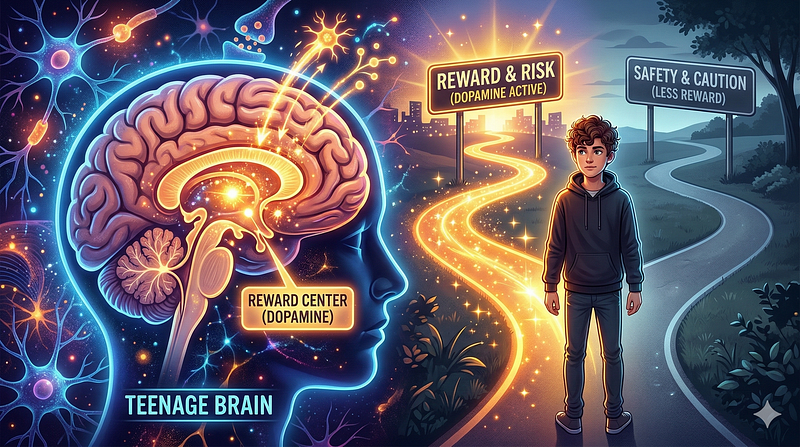
The problem isn’t knowledge. It’s neurochemistry.
Specifically, it’s dopamine.
· · ·
The Dopamine Drive: Why Thrills Feel So Good
In the previous blog, we explored how the teenage brain is under construction ~ how the prefrontal cortex (the CEO of rational thinking) won’t be fully developed until the mid-twenties.
But there’s another piece of the puzzle that’s equally important: dopamine.
Dopamine is a neurotransmitter, a chemical messenger in the brain. It’s often called the “feel-good” chemical, but that’s not quite accurate.
Dopamine is really about reward and motivation.
It’s the chemical that makes you feel excited about something you want. It’s what drives you to pursue goals, seek new experiences, and feel pleasure when you achieve something.
And during adolescence, the dopamine system goes through dramatic changes.
· · ·
What Changes in the Teenage Brain
Here is what neuroscience has discovered:
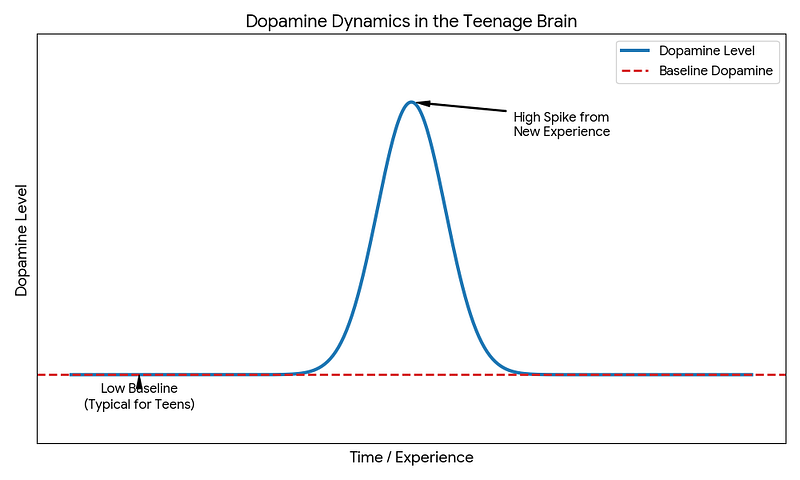
1. Baseline dopamine levels are LOWER in teenagers.
This means that in their everyday resting state, teenagers have less dopamine circulating than children or adults.
What does this feel like from the inside?
Boredom.
That persistent sense of “there’s nothing to do,” the restlessness, the dissatisfaction with ordinary life ~ this isn’t teenagers being difficult. It’s neurochemistry.
2. Dopamine RELEASE is HIGHER in response to new experiences.
When something exciting, novel, or thrilling happens, the teenage brain releases MORE dopamine than an adult brain would for the same experience.
This means new experiences feel really, really good to teenagers. Intensely good. Memorably good.
The combination is powerful:
Low baseline (feeling bored) + High release (new things feel amazing) = Constant drive toward novelty and excitement.
This is why your teenager can’t just be content with a quiet evening at home. This is why they’re always seeking the next thing ~ the next experience, the next thrill, the next hit of something that makes them feel alive.
· · ·
The Three Ways This Shows Up
Dr. Daniel Siegel identifies three ways the increased reward drive affects teenage behavior:
1. Impulsivity: “I Did It Before I Thought About It.”
Sometimes, teenagers act without any pause between impulse and action.
They see an opportunity for excitement, and they take it ~ instantly. No reflection. No consideration of consequences. Just action.
This is pure impulsivity.
Example: Your son is walking past a construction site with friends. Someone dares him to climb the scaffolding. Before he’s even consciously decided, he’s climbing. It’s only later ~ sometimes much later ~ that he thinks, “That was really dangerous. Why did I do that?”
The dopamine-driven impulse was faster than the prefrontal cortex could respond.
2. Addiction Vulnerability: “I Can’t Stop Even Though I Want To”
All addictive substances and behaviors work through the dopamine system. They trigger dopamine release, creating feelings of pleasure and reward.
Because teenagers have a more reactive dopamine system, they are significantly more vulnerable to addiction than adults.
This applies to:
- Substances (alcohol, drugs, nicotine)
- Behaviors (gaming, social media, pornography, gambling)
- Even food (high-sugar, high-fat foods trigger dopamine too)
What starts as experimentation can quickly become a cycle: the substance or behavior spikes dopamine, then dopamine crashes, creating craving, leading to more of the substance or behavior.
This is why the teenage years are the highest-risk period for developing addictions that can last a lifetime.
3. Hyperrationality: “I Calculated the Odds and Decided It Was Worth It.”
This is the one that confuses parents most.
Sometimes teenagers don’t act impulsively at all. They actually think about what they’re doing. They weigh the options. They consider the risks.
And then they do the risky thing anyway.
This is called hyperrationality, and it’s different from both impulsivity and ignorance.
· · ·

Hyperrationality: The Most Misunderstood Part
Let me explain hyperrationality with an extreme example from Dr. Siegel.
Imagine someone offers you $6 million to play Russian roulette ~ one bullet, six chambers.
A purely rational calculation would say: You have a 5-in-6 chance of winning $6 million. The “expected value” is about $5 million. Those are pretty good odds.
But no healthy adult would take that bet. Why?
Because we don’t just calculate odds. We have a gut feeling that screams: This is insane. My life is worth more than any amount of money. One-in-six chance of death is not acceptable.
This gut feeling ~ this intuition that overrides pure calculation, is called gist thinking.
Adults have well-developed gist thinking. We get a “sense” of whether something is a good or bad idea that goes beyond the numbers.
Teenagers are still developing gist thinking.
Instead, they often rely on hyperrational thinking, pure calculation without the gut check.
And here’s the problem:
When you calculate purely, the pros often outweigh the cons.
· · ·
What Hyperrationality Looks Like
Scenario 1: Your daughter is deciding whether to sneak out to a party.
Her calculation:
- PRO: Amazing time with friends, exciting stories, feeling alive, social status ✓
- PRO: Probably won’t get caught (she’s been careful before) ✓
- PRO: Everyone else is going; she’ll be left out if she doesn’t ✓
- CON: Might get caught (low probability)
- CON: Parents will be upset (manageable)
The pros outweigh the cons. She goes.
Scenario 2: Your son is deciding whether to try a vape pen that his friend offers.
His calculation:
- PRO: Curious what it feels like ✓
- PRO: Will bond with this friend group ✓
- PRO: One time won’t hurt anything ✓
- PRO: Everyone does it, and they’re fine ✓
- CON: Could be bad for health (but that’s long-term, abstract)
- CON: Could get in trouble (but probably won’t get caught)
The pros outweigh the cons. He tries it.
Scenario 3: Your teenager is deciding whether to cheat on an exam.
Their calculation:
- PRO: Better grade, less stress, parents happy ✓
- PRO: Low chance of getting caught ✓
- PRO: Everyone cheats sometimes ✓
- CON: Could get caught (but probably won’t)
- CON: It’s “wrong” (but the system is unfair anyway)
The pros outweigh the cons. They cheat.
· · ·
In none of these scenarios is the teenager unaware of the risks. They are not being stupid. They’re being hyperrational.
They are doing the math. The problem is, their brain is weighing the rewards much more heavily than the risks.
· · ·
The Peer Multiplier Effect
Everything I have just described gets amplified when peers are involved.
Research shows that teenagers take significantly more risks when they’re with friends ~ or even when they believe friends are watching ~ than when they are alone.
This isn’t just social pressure in the traditional sense (“come on, everyone’s doing it”). It’s neurological.
The presence of peers actually changes how the teenage brain processes reward. The dopamine system becomes even more reactive. The potential thrill feels even more thrilling. The pros get even heavier on the scale.
· · ·
A story that illustrates this:
A friend’s son ~ let’s call him Rohan~ was a sensible 15-year-old. Academically focused. Not a “troublemaker.”
During a school trip to a hill station, some boys decided to climb to a restricted area near a waterfall ~ clearly marked as dangerous, clearly off-limits.
Rohan knew it was risky. He knew the rules. He is not someone who typically breaks rules.
But in that moment, with his friends heading toward the waterfall, with the excitement building, with the fear of being the one who stayed behind…
He went.
Later, when his mother asked him about it, he said something that stuck with her:
“I knew it was stupid, Mom. But in that moment, it didn’t FEEL stupid. It felt like the most important thing was to go with them.”
This is the peer multiplier. The rational knowledge was there. But the emotional weight of social belonging, combined with the dopamine drive, tipped the scales.

· · ·
What This Means for Your Parenting
If you have been relying on education and warnings to keep your teenager safe, I have difficult news:
“Don’t do it” doesn’t work.
Telling your teenager about risks, showing them statistics, even sharing scary stories ~ none of this is enough to override a dopamine system that’s weighing the rewards so heavily.
This doesn’t mean education is useless. Your teenager needs accurate information.
But information alone won’t save them in the moment when their brain is calculating that the thrill is worth it.
So what does work?
· · ·
1. Promote the Positive, Not Just Prohibit the Negative
Instead of only telling your teenager what NOT to do, help them find healthy sources of dopamine.
The teenage brain is going to seek novelty, excitement, and reward. That’s non-negotiable. The question is: What will provide it?
- Adventure and physical challenge ~ trekking, rock climbing, martial arts, competitive sports
- Creative expression ~ music, art, dance, theatre
- Social connection ~ meaningful friendships, group activities, community involvement
- Mastery and achievement ~ learning new skills, taking on challenges, building something
- Meaningful risk~ not reckless risk, but calculated risk with growth potential (starting a project, performing on stage, competing)
A teenager whose life is full of healthy dopamine sources is less likely to seek unhealthy ones.
· · ·
2. Strengthen the Gut Check
Remember gist thinking ~ that intuitive sense that something is a bad idea, even if the math seems okay?
This can be developed.
Help your teenager practice listening to their body:
- “When you imagine doing that, what does your stomach feel like?”
- “Does this feel right in your gut, or does something feel off?”
- “What would your future self ~ five years from now ~ think about this choice?”
These questions move decision-making from pure calculation to embodied wisdom.
At our BECOMING retreats, we spend significant time helping teenagers connect with their body’s signals ~ not just their mind’s calculations. Because in the moment of decision, the gut speaks faster than the brain.
· · ·
3. Make the Cons More Concrete
The reason pros outweigh cons in teenage calculation is partly because pros feel immediate and vivid, while cons feel abstract and distant.
“I might get addicted” is abstract. “My cousin spent three years unable to stop, lost his friends, dropped out of college” is concrete.
“I might get hurt” is abstract. “Here’s a photo of someone who was paralyzed doing exactly this” is concrete.
I am not suggesting you terrorize your teenager. But helping them connect with real stories, real consequences, real people who faced the outcomes they are dismissing as “unlikely” ~ this makes the cons more vivid.
· · ·
4. Address the Peer Factor Directly
Since peers amplify risk-taking, talk about this openly:
“I know that when you are with friends, things that seem risky alone can suddenly seem fine. That’s not weakness ~ that’s how the brain works. What’s your plan for when you feel that pull?”
Help them develop scripts they can use:
- “I am the one who has to deal with my parents ~ you don’t.”
- “I’ll catch up with you guys later.”
- “I am good ~ you go ahead.”
Role-play these. Make them automatic. In the moment, your teenager needs something to say that doesn’t require them to think ~ because the prefrontal cortex might not be available.
· · ·
5. Stay the Anchor, Even When They Pull Away
Here is a finding that might comfort you:
Research shows that teenagers who have strong, connected relationships with parents take fewer dangerous risks ~ even when parents aren’t present.
Why?
Because the relationship itself becomes part of the calculation.
“If I do this and something goes wrong, it will hurt my mom.” “My dad trusts me. I don’t want to break that.” “I want to be able to tell my parents about my life. This would create a secret I’d have to keep.”
The relationship adds weight to the “cons” side ~ not through fear of punishment, but through connection.
Your presence in their life is protective, even when you are not physically present.
This is why the work of staying connected ~ even through conflict, even through the pushing away ~ matters so much.
· · ·
A Personal Reflection
I’ll be honest: when Aarya hit her teenage years, I was afraid.
I’d heard all the horror stories. I knew the statistics about teenage risk-taking. I’d seen families torn apart by one bad decision.
And I found myself becoming controlling. Monitoring everything. Asking constant questions. Trying to eliminate any possibility of her making a mistake.
What I didn’t realize was that my fear was driving her away ~ which was actually making her less safe, not more.
The more I tried to control, the less she told me. The less she told me, the more anxious I became. The more anxious I became, the more I tried to control.
It was a spiral.
What broke the spiral was understanding her brain ~ understanding that she wasn’t trying to hurt me or destroy her life. She was experiencing the world through a brain that was wired for novelty, excitement, and risk.
My job wasn’t to eliminate that wiring. It was to:
- Provide healthy outlets for it
- Strengthen her ability to listen to her gut
- Keep our relationship strong enough that I stayed in her calculation
- Trust that she was building the capacity to make good decisions ~ even when she sometimes didn’t
That shift ~ from control to connection, from fear to understanding ~ changed everything.
She still takes risks. She still sometimes makes choices I wish she wouldn’t. But she also talks to me. She asks for my input. She lets me into her world.
And that’s worth more than any amount of surveillance could ever provide.

· · ·
Five Things You Can Do This Week
1. Audit your teenager’s dopamine diet
What is currently providing your teenager with excitement and novelty?
Make a list. Is it mostly screens, social media, passive entertainment? Or does it include physical adventure, creative challenge, meaningful social connection, and mastery experiences?
Look for gaps. Then have a conversation: “What’s something exciting or challenging you’d like to try?”
· · ·
2. Practice the gut check together
The next time your teenager is making a decision ~ even a small one ~ ask:
“What does your gut tell you about this?”
If they say “I don’t know,” help them: “Close your eyes. Imagine doing it. What do you notice in your body?”
Build this muscle in low-stakes situations so it’s available in high-stakes ones.
· · ·
3. Share a story of your own hyperrationality
Tell your teenager about a time YOU did something risky, even though you knew better.
Be honest about the calculation you made. Be honest about what happened ~ good or bad.
This does two things: It normalizes the experience (they’re not broken), and it opens the door for them to share with you.
· · ·
4. Have the “peer pressure” conversation differently
Instead of: “Don’t give in to peer pressure.”
Try: “Your brain is wired to feel like what your friends think matters more than anything in the moment. That’s normal. So let’s figure out what you can do when you feel that pull.”
Develop specific phrases or plans together.
· · ·
5. Strengthen the relationship, not the surveillance
This week, find one way to connect with your teenager that has nothing to do with monitoring, correcting, or advising.
- Watch something they want to watch
- Ask about something they’re interested in ~ and just listen
- Share something about your own life
- Do an activity together without an agenda
Every moment of genuine connection adds weight to the “cons” side of their future calculations.
· · ·
What’s Coming Next
Now that you understand the dopamine drive, we’re ready to explore another powerful force in your teenager’s life:
The pull toward peers.
In Blog 5, we’ll answer the question that stings every parent:
“When Friends Become Everything, and You Become Nothing”
You’ll know why your teenager’s brain is biologically wired to prioritize friends over family right now ~ and what you can do to stay connected without competing.
· · ·
Join our WhatsApp community to get the next blog delivered directly to your phone ~ plus connect with other parents navigating the teenage years.
· · ·
Preeti Toraskar is the founder of Young SoulTales, where children’s emotional development is the curriculum. She’s completing her Master’s in Expressive Movement Therapy in 2026, she has trained with Dr. Daniel Siegel, and is the mother of a 14-year-old Aarya
