
The Brainstorm Series: Blog 3 of 13
I remember the moment I realized I had no idea what was happening inside my daughter’s brain.
Aarya was 13. We were in the car, running late for a family function. I asked her ~ calmly, I thought ~ to put her phone away so we could talk about the plan for the evening.
What followed was an explosion I wasn’t prepared for.
“Why do you ALWAYS do this? You don’t trust me! You treat me like a child! I HATE when you control everything!”
I gripped the steering wheel. My own heart was pounding now.
“I just asked you to put your phone down. Why are you making this into a big deal?”
“BECAUSE IT IS A BIG DEAL! You don’t get it! You NEVER get it!”
She turned toward the window. I turned up the AC. We drove the rest of the way in thick, uncomfortable silence.
At the function, she was fine. Laughing with cousins. Charming the aunties. As if nothing had happened.
I stood in the corner, still shaken, wondering: What just happened? Who was that person in the car? And where did she go?
· · ·
If you have ever witnessed your teenager go from zero to explosive in seconds and then back to “normal” just as quickly, you are not alone.
And you are not imagining it.
Something IS different about the teenage brain.
But it’s not what you think. It’s not “raging hormones.” It’s not a character flaw. It’s not that they are trying to make your life difficult.
It’s architecture.
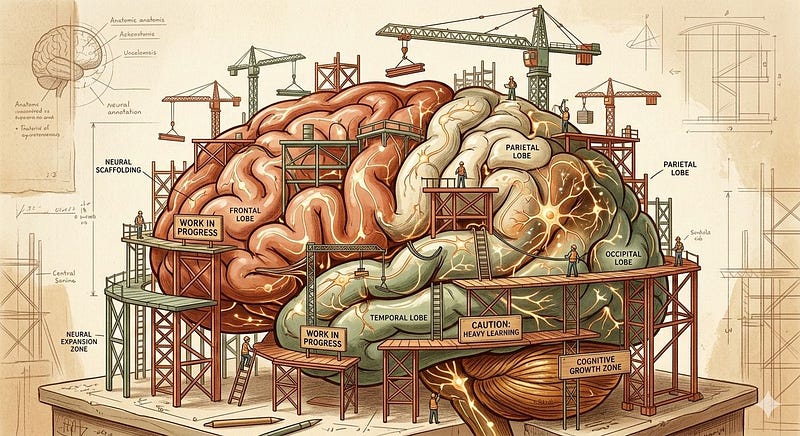
The teenage brain is undergoing the most significant renovation since the first three years of life. And once you understand what’s happening inside, everything your teenager does starts to make sense.
· · ·
The Great Remodeling Project
In the first blog of this series, we explored the developmental map that psychologists drew decades ago. In the second blog, we busted three myths about teenagers that make parenting harder.
Now it’s time to go inside the brain itself.
Here is what neuroscience tells us:
Between ages 12 and 24, the brain undergoes a massive remodeling process.
This isn’t gradual, gentle growth. This is demolition and reconstruction. The brain is literally tearing down old structures and building new ones.
Two key processes drive this renovation:
1. Pruning: “Use It or Lose It”
During childhood, the brain creates an abundance of neural connections, far more than it will ever need. Think of it like a garden that’s been allowed to grow wild, with branches and vines going in every direction.
During adolescence, the brain starts pruning.
Connections that are used regularly get strengthened. Connections that aren’t used get eliminated.
This is the brain’s way of becoming more efficient. Instead of a wild garden, it’s creating a well-designed landscape, keeping the pathways that matter and clearing away the rest.
What this means for your teenager:
The activities, experiences, and skills they practice during adolescence literally shape the architecture of their adult brain. What they spend time on ~ music, sports, academics, video games, meaningful conversations, or scrolling social media ~ strengthens those particular neural pathways.
The teenage years aren’t just “passing time until adulthood.” They’re the window when the brain decides what to keep and what to discard.
2. Myelination: “The Speed Upgrade”
While pruning is happening, another process is underway: myelination.
Myelin is a fatty substance that coats neural pathways ~ like insulation around electrical wires. When a pathway is myelinated, signals travel up to 100 times faster.
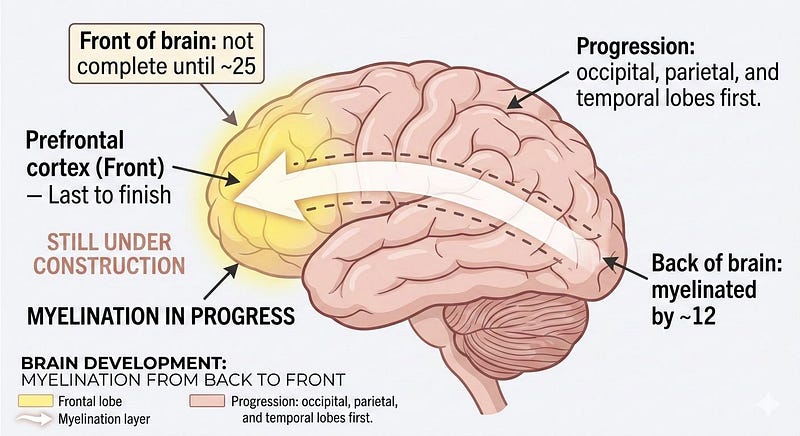
During adolescence, the brain is myelinating rapidly ~ but not all at once. It starts from the back of the brain and moves toward the front.
This is crucial.
The back of the brain handles things like sensory processing, movement, and basic survival instincts. This gets myelinated first.
The front of the brain ~ the prefrontal cortex ~ handles planning, impulse control, considering consequences, and regulating emotions. This gets myelinated last.
And when I say “last,” I mean it won’t be complete until the mid-twenties.
· · ·
The Prefrontal Cortex: The CEO That’s Still in Training
The prefrontal cortex is sometimes called the “CEO of the brain.”
It’s responsible for:
- Planning and organization ~ thinking ahead, setting goals
- Impulse control ~ pausing before acting
- Considering consequences ~ understanding cause and effect
- Emotional regulation ~ calming down when upset
- Decision-making ~ weighing options, making judgments
- Empathy and perspective-taking ~ understanding how others feel
In other words, everything we expect “mature” adults to do well.
Here is the problem:
Your teenager’s CEO is still in training.
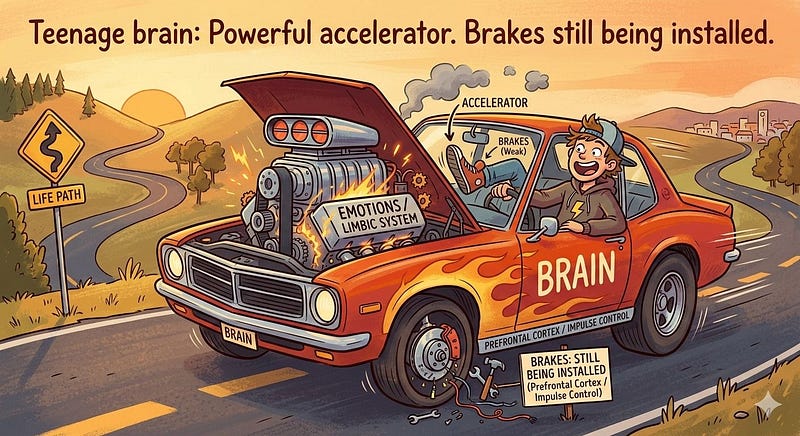
The prefrontal cortex is the last part of the brain to fully develop. During adolescence, it’s online ~ but it’s not fully operational. It’s like having a CEO who’s brilliant but only works part-time, and sometimes doesn’t show up at all when things get stressful.
Meanwhile, the emotional centers of the brain ~ the limbic system, including the amygdala ~ are fully developed and highly active.
This creates an imbalance:
Strong emotional accelerator. Weak cognitive brakes.
· · ·
What This Looks Like in Real Life
Scenario 1: Your daughter spends three hours perfecting an Instagram post instead of studying for tomorrow’s exam. You think: She has no sense of priorities!
What’s happening: Her limbic system (seeking social reward, dopamine hit) is fully operational and screaming for attention. Her prefrontal cortex (considering future consequences) isn’t strong enough to override it yet.
Scenario 2: Your son promises to be home by 10 pm. At 11:30 pm, you are panicking. He finally shows up and seems genuinely confused by your anger: “What’s the big deal? I was just hanging out.”
What’s happening: In the moment with friends, his brain prioritized the immediate social experience. The prefrontal cortex that would calculate “if I stay late → parents will worry → I’ll get in trouble” simply wasn’t activated.
Scenario 3: Your teenager says something cruel in anger. An hour later, they seem completely fine and don’t understand why you are still upset.
What’s happening: The emotional intensity was real ~ but the prefrontal cortex that would help them consider impact, remember the event, and regulate the aftermath is still developing. They are not being callous. Their brain processed it differently than yours did.
· · ·
The Hand Model: A Tool You Can Use Tonight
Dr. Daniel Siegel created a simple, powerful way to understand the brain ~ using your hand.
I teach this to parents and teenagers alike. Once you learn it, you will never forget it.
Try this now:
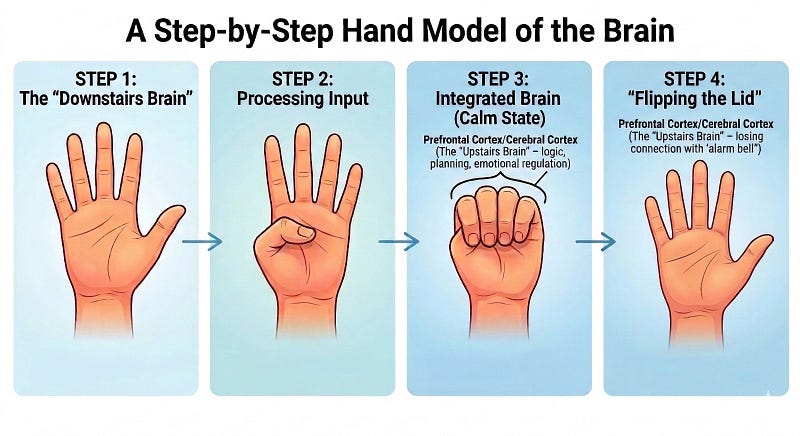
Step 1: Hold up your hand, palm facing you.
Step 2: Fold your thumb across your palm.
Your thumb represents the limbic system ~ the emotional center of the brain. This is where big feelings live: fear, anger, sadness, joy, excitement. This is also where the amygdala sits ~ the brain’s alarm system that detects threats.
Step 3: Now fold your four fingers over your thumb, making a fist.
Your fingers represent the prefrontal cortex ~ the thinking, reasoning, regulating part of the brain. Notice how your fingers (prefrontal cortex) wrap around and cover your thumb (limbic system). When everything is working well, the prefrontal cortex helps regulate emotions.
Step 4: Now flip your fingers up ~ open your fist while keeping the thumb folded.
This is what happens when we “flip our lid.”
The prefrontal cortex goes offline. The limbic system is exposed and running the show. There is no regulation, no rational thinking, no impulse control.
We have all been there. Your teenager has been there ~ probably today.
· · ·
Why Teenagers Flip Their Lids More Often
Here is the key insight:
Because the teenage prefrontal cortex is still developing, it takes less stress to flip the lid.
Adults have a more developed prefrontal cortex, so we can handle more pressure before we lose access to rational thinking. (Though we still flip our lids too ~ be honest with yourself.)
Teenagers have a thinner margin. The lid flips faster. And once it’s flipped, they literally cannot access the part of the brain that would help them calm down, think logically, or consider consequences.
This is not a choice. This is neurobiology.
· · ·
What Happens When the Lid Flips
Let me take you back to that car ride with Aarya.
When I asked her to put her phone away, something in that request triggered her. Maybe she felt controlled. Maybe she was already stressed about the family function. Maybe she’d had a hard day and this was the last straw.
Whatever it was, her amygdala sounded the alarm: Threat detected.
Her lid flipped.
In that moment, she lost access to:
- The ability to see my perspective
- The ability to regulate her tone
- The ability to pause before responding
- The ability to consider that I wasn’t actually attacking her
What she had access to:
- Big, intense emotions
- Fight-or-flight responses
- The overwhelming sense that something was WRONG
She wasn’t choosing to be difficult. Her prefrontal cortex had gone offline. She was operating from pure emotional brain.
And here is the part that’s hard to admit:
My lid flipped too.
When she exploded, my own amygdala went on alert. My heart rate increased. My jaw tightened. I felt the urge to either fight back (lecture, punish, assert control) or withdraw (silent treatment, cold distance).
Two flipped lids in one small car. No wonder it felt like a war zone.
· · ·
The Most Important Thing to Know About Flipped Lids
When someone’s lid is flipped ~ yours or your teenager’s ~ logic doesn’t work.
You cannot reason with a flipped lid. You cannot explain, lecture, teach, or problem-solve your way through it. The part of the brain that would receive that information is offline.
This is why “calm down” never works. This is why explaining your position in the middle of a meltdown goes nowhere. This is why your most logical arguments fall on deaf ears when emotions are running high.
We will explore this much more deeply in Blog 7 of this series ~ “Stop Trying to Calm Them Down: What to Do Instead.” I will share specific strategies for what actually works when your teenager’s lid has flipped.
For now, just know this: When the lid flips, connection comes before correction. Always.

· · ·
The Brain-Body Connection: What I Wish I’d Known Sooner
Here’s something that changed everything for me ~ both as a parent and as someone training in Expressive Movement Therapy.
The brain doesn’t operate in isolation. It’s deeply connected to the body.
When your teenager’s lid flips, it’s not just happening in their head. Their entire body is activated:
- Heart rate increases
- Breathing becomes shallow and fast
- Muscles tense ~ especially jaw, shoulders, stomach
- Digestion slows down
- Stress hormones flood the system
The body is preparing for fight or flight. It doesn’t know the “threat” is just a parent asking about homework. It responds as if there’s real danger.
This is why you can’t just think your way out of a flipped lid.
The fastest path back to regulation often isn’t through the mind ~ it’s through the body.
· · ·
What This Looks Like in Practice
After that car ride explosion with Aarya, I spent days replaying it, trying to figure out where I went wrong.
What I eventually realized: I kept trying to talk us both through it. Words, words, more words. Explanations. Reasoning. Arguments.
But words live in the prefrontal cortex ~ the part that was offline for both of us.
What might have worked better:
- Taking a few deep breaths myself before responding ~ signaling to my nervous system that there’s no real danger
- Lowering my voice and slowing my speech ~ which actually helps regulate the other person’s nervous system too
- Suggesting we both take a pause ~ “Let’s take a break and come back to this in 10 minutes”
- Movement ~ if possible, taking a walk together, or even just letting her put on her earphones and look out the window while the nervous systems settled
The body calms the brain faster than the brain calms the brain.
This is why at our retreats ~ both for teenagers and adults ~ we don’t just sit and talk. We move. We breathe. We use the body as a pathway back to regulation. Because that’s how the nervous system actually works.

· · ·
The Good News: Integration Is the Goal
If all of this sounds overwhelming, here’s the hopeful part:
The remodeling has a purpose. And that purpose is integration.
Integration means different parts of the brain learn to work together ~ the emotional and the logical, the reactive and the reflective, the impulsive and the thoughtful.
The goal of adolescent brain development isn’t to suppress emotions or become perfectly rational. It’s to integrate ~ to have access to the full range of human experience while also being able to regulate, reflect, and respond thoughtfully.
Dr. Siegel says it this way: Integration creates harmony.
A well-integrated brain is:
- Flexible ~ can adapt to different situations
- Adaptive ~ learns from experience
- Coherent ~ has a stable sense of self
- Energized ~ feels vital and alive
- Stable ~ doesn’t get swept away by every emotion
This is what your teenager’s brain is working toward. The chaos, the intensity, the unpredictability ~ these are all signs that the remodeling is happening.
Your job isn’t to stop the renovation. It’s to provide a stable foundation while it happens.
· · ·
Five Things You Can Do This Week
1. Learn the Hand Model ~ and teach it to your teenager
This week, practice making a fist and “flipping your lid” with your hand. Then show it to your teenager.
Say something like: “I learned something about how the brain works. Can I show you?”
This gives you shared language. The next time emotions run high, you can say (to yourself or to them): “I think my lid is about to flip” or “Let’s talk when both our lids are back down.”
· · ·
2. Watch for your own lid flipping
Before you can help your teenager regulate, you need to notice when YOU’RE dysregulated.
Signs your lid is flipping:
- Heart pounding
- Jaw clenching
- Urge to yell or withdraw
- Thoughts like “I can’t take this anymore”
- Feeling like you are about to say something you’ll regret
When you notice these signs, pause. Take three slow breaths. Give yourself a moment before responding.
· · ·
3. Stop talking when the lid has flipped
The next time your teenager is in full emotional flood, resist the urge to explain, lecture, or reason.
Instead, try:
- Saying less, not more
- Lowering your voice
- Making your presence calm and steady
- Waiting for the storm to pass before discussing what happened
Remember: You cannot reason with an offline prefrontal cortex. Wait for it to come back online.
· · ·
4. Use the body to help the brain
When emotions are high ~ yours or theirs ~ try a body-based intervention:
- “Let’s take a walk around the block.”
- “Take a few deep breaths with me.”
- “Go splash some cold water on your face ~ it actually helps.”
- “Let’s sit outside for a few minutes before we talk.”
The body calms the brain faster than the brain calms the brain.
· · ·
5. Reframe “bad behavior” as “brain under construction”
The next time your teenager does something impulsive, reactive, or seemingly irrational, remind yourself:
“This isn’t defiance. This is a prefrontal cortex that’s still being built.”
This doesn’t mean no consequences. It means you deliver those consequences with understanding rather than contempt.
“I know this is hard. Your brain is still learning how to do this. AND this behavior isn’t okay. Let’s figure out what to do differently next time.”
· · ·
What’s Coming Next
Now that you understand the architecture of the teenage brain, we are ready to explore one of the most powerful ~ and most misunderstood ~ aspects of adolescence:
The Dopamine Drive.
In Blog 4, I will answer the question every parent asks:
“Why Does My Teen Do Stupid Things (Even Though They are Not Stupid)?”
You’ll learn about dopamine, the reward system, and why your teenager is wired to seek thrills, take risks, and prioritize excitement over safety.
And most importantly ~ what you can do about it.
· · ·
Join our WhatsApp community to get the next blog delivered directly to your phone ~ plus connect with other parents navigating the teenage years.
· · ·
Preeti Toraskar is the founder of Young SoulTales, where children’s emotional development is the curriculum. She’s completing her Master’s in Expressive Movement Therapy in 2026, she has trained with Dr. Daniel Siegel, and is the mother of a 14-year-old Aarya
