

I remember the exact moment I felt it for the first time.
Aarya was 13. We were at a family wedding ~ the kind with hundreds of people, loud music, and cousins running everywhere.
For years, she’d been my shadow at these events. Holding my hand. Checking in with me. Finding me in the crowd when she felt overwhelmed.
But this time was different.
She spotted a group of girls her age ~ some cousins, some friends of cousins, and within minutes, she was absorbed into their circle. Laughing at inside jokes I wasn’t part of. Whispering about things I couldn’t hear. Glancing at her phone constantly, probably texting someone who wasn’t even there.
I stood at the edge of the hall, holding a plate of food, watching her.
She didn’t look for me once.
When it was time to leave, I had to send her three messages before she responded. She came reluctantly, annoyed that I was “rushing her,” and spent the entire car ride texting the same girls she’d just been with.
“How was it?” I asked.
“Fine.”
“Did you have fun with your cousins?”
“Yeah.”
“What did you talk about?”
“Nothing.”
And that was it. The girl who used to narrate every detail of her day to me now offered single-word answers. The girl who used to seek me out in a crowd now seemed to forget I existed.
I told myself it was just a phase. But something in my chest ached.
When did I become irrelevant?
· · ·
The Question That Keeps Parents Up at Night
If you’ve ever felt like you’ve been replaced, like you went from being the center of your child’s world to being a background character they barely notice, you’re not alone.
Parents describe it in different ways:
“She tells her friends things she’d never tell me.”
“He acts like spending time with family is punishment.”
“I used to know everything about her life. Now I know nothing.”
“He’s a different person with his friends ~ laughing, talking, engaged. With us, he’s just… absent.”
“I feel like I’m running a hotel. She comes home to sleep and eat, and that’s it.”
The feeling underneath all of these is the same:
I’ve lost my child. And I don’t know how to get them back.
Here’s what I want you to know:
You haven’t lost them. And this isn’t rejection ~ at least, not in the way it feels.
This is biology doing exactly what it’s supposed to do.
· · ·
Why Peers Become Everything
In Blog 1 of this series, I introduced you to Albert Bandura’s social learning theory ~ the idea that we learn by watching and imitating others.
During childhood, the primary “others” we learn from are parents. You were the model. Your child watched how you handled stress, how you talked to people, what you valued. They absorbed your way of being in the world.
But during adolescence, something fundamental shifts.
The primary models change from parents to peers.
This isn’t a choice your teenager is making. It’s not that they’ve decided friends are better than you. It’s that their brain is rewiring to prioritize a different kind of learning.
· · ·
The Evolutionary Logic
Think about it from an evolutionary perspective:
For thousands of years, the task of adolescence was to prepare to leave the family unit and survive in the larger world. To do that successfully, a teenager needed to:
- Learn from people navigating the same challenges ~ other young people figuring out identity, relationships, social dynamics
- Build alliances outside the family ~ friendships and eventually partnerships that would support them in adulthood
- Develop social skills for the wider world ~ learning to read social cues, negotiate status, handle conflict with non-family members
Parents couldn’t teach these things the same way peers could. Parents had already figured it out. Peers were in the same boat, struggling, experimenting, learning together.
The shift toward peers isn’t a bug in adolescent development. It’s a feature.
Your teenager’s brain is preparing them to leave you. And the way it does that is by making peers feel incredibly important ~ more important, in the moment, than family.

· · ·
What’s Happening in the Brain
The dopamine system we explored in Blog 4 plays a role here too.
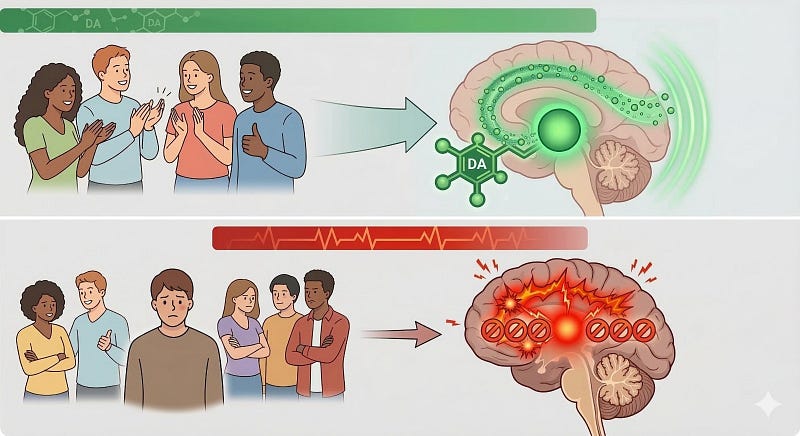
Social acceptance, especially from peers, triggers significant dopamine release in the teenage brain. Being included, liked, and valued by friends feels really good. Being excluded, rejected, or ignored feels really bad, disproportionately bad compared to how it might feel to an adult.
Research using brain imaging shows that when teenagers experience social rejection, the same areas of the brain light up as when they experience physical pain.
Let me say that again:
Social rejection registers as physical pain in the teenage brain.
This is why your teenager seems to care so much about what friends think. This is why a comment from a classmate can ruin their entire week. This is why being left out of a group chat feels like the end of the world.
It’s not that they’re being dramatic. Their brain is processing social information with an intensity that adults don’t experience anymore.
· · ·
The Peer Reward System
Here’s what’s happening neurologically:
- Heightened sensitivity to social reward: Acceptance by peers triggers more dopamine in teenage brains than in adult brains
- Heightened sensitivity to social punishment: Rejection by peers triggers stronger pain responses
- Increased attention to social cues: Teenage brains are hyperaware of social dynamics ~ who’s in, who’s out, who said what, what it all means
This creates a perfect storm:
Peers feel incredibly rewarding when things are good. And incredibly painful when things are bad.
No wonder your teenager is obsessed with friends. Their brain is making friends feel like the most important thing in the world ~ because from an evolutionary standpoint, social bonds outside the family were critical for survival.
· · ·
What This Looks Like in Daily Life
Let me show you how this biology plays out in ordinary moments:
Scenario 1: The Dinner Table Disappearance
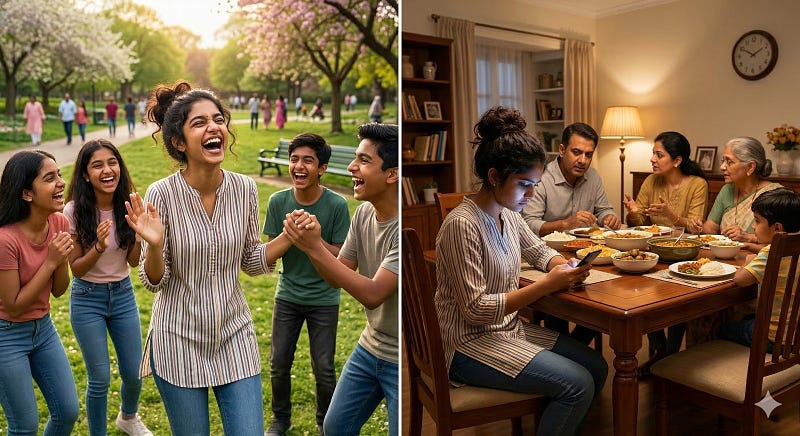
You call everyone for dinner. Your teenager appears, phone in hand, sits down, and proceeds to text throughout the meal. When you ask about their day, you get one-word answers. The moment they’ve eaten enough to be excused, they vanish back to their room.
Meanwhile, you’ve seen them on video calls with friends for hours ~ animated, engaged, laughing.
What’s happening:
Conversation with friends is high-dopamine. It’s novel, dynamic, full of social rewards. Conversation with family is low-dopamine. It’s predictable, routine, and (sorry to say this) not socially “valuable” in the way peer interaction is.
This doesn’t mean they don’t love you. It means their brain is prioritizing differently right now.
· · ·
Scenario 2: The Secret Life
Your daughter tells her best friend everything ~ her crushes, her fears, her embarrassing moments, her dreams. She tells you almost nothing.
When you ask questions, she says, “You wouldn’t understand,” or “It’s nothing,” or just shrugs.
What’s happening:
Sharing with peers feels safe in a different way than sharing with parents. With friends, there’s mutual vulnerability ~ they’re all figuring things out together. With parents, there’s a power imbalance. She may fear judgment, lectures, or consequences. She may also be protecting her emerging identity ~ keeping parts of herself private as she figures out who she is.
This doesn’t mean she doesn’t trust you. It means she’s developing the capacity for intimate friendships, which is actually a healthy developmental step.
· · ·
Scenario 3: The Weekend War
Every weekend becomes a negotiation. Your son wants to spend all his time with friends. You want family time. He acts like being home is a prison sentence. You feel hurt and resentful.
What’s happening:
His brain is telling him that peer time is essential ~ which, developmentally, it is. Your brain remembers when family time was easy and wanted. Both of you are responding to valid needs. The conflict is about the transition, not about love.
· · ·
Scenario 4: The Personality Shift
With friends, your teenager is confident, funny, engaged. With family, they’re moody, withdrawn, easily irritated. You wonder: Which one is the real them?
What’s happening:
Both are real. With friends, they’re performing their emerging adult self, the identity they’re trying on. With family, they’re in the old context where they were a child. It’s hard to be your “new self” in the place where everyone remembers your old self. The moodiness at home is partly the awkwardness of this transition.
· · ·
The Part That Hurts Most
Let me name something that most parenting articles won’t say:
This hurts.
It hurts to be de-prioritized by someone you love. It hurts to feel irrelevant to a person you’ve poured yourself into for years. It hurts to watch them light up for friends and shut down for you.
And it’s okay to feel that hurt.
You don’t have to pretend it’s fine. You don’t have to be so “evolved” that you feel nothing. The ache is real, and it’s valid.
· · ·
I remember a conversation with my own mother during this phase with Aarya.
“She’s slipping away,” I told her. “I feel like I don’t know her anymore.”
My mother laughed ~ not unkindly. “You did the same thing to me,” she said. “You think I didn’t notice? You told your friends things you never told me. You couldn’t wait to get out of the house. I wondered where my daughter went.”
“What did you do?” I asked.
“I stayed,” she said. “I kept showing up. I let you go, and I stayed. Eventually, you came back.”
She was right. I did come back. Not as a child, but as an adult who chose her.
Your teenager will come back too. But first, you have to let them go.
· · ·
The Crucial Distinction: Letting Go vs. Giving Up
Here’s where many parents get confused:
Letting go is not the same as giving up.
Giving up says, “Fine, you don’t want me around. I’ll stop trying.”
Letting go says: “I see you need space. I’m giving you that space. And I’m still here when you need me.”
Giving up creates distance and resentment.
Letting go creates trust and security.
· · ·
Remember John Bowlby’s attachment theory from Blog 1? Adolescents still need two things from parents:
- A safe harbor ~ a place to return when they’re hurt, scared, or overwhelmed
- A launching pad ~ the confidence and permission to explore the world
You can’t be a launching pad if you’re clinging to them. But you also can’t be a safe harbor if you’ve disappeared.
The task is to hold both: Let them go AND stay present.

· · ·
What About Indian Families?
I want to acknowledge something specific about our context.
In Indian families, there’s often an expectation of closeness that Western parenting books don’t address. We’re not just a nuclear unit, we’re part of an extended family, community, tradition. The idea that a teenager would prioritize friends over family can feel like a betrayal of values, not just a developmental phase.
“We did everything together as a family.” “In our family, we don’t keep secrets from parents.” “Friends come and go. Family is forever. Why doesn’t she understand that?”
Add to this the pressure from relatives: “Your son doesn’t talk to you? What’s wrong with your parenting?”
And the comparison: “My daughter tells me everything. We’re best friends.”
This makes the natural pulling away feel even more painful and even more shameful.
Here’s what I want to say:
Your teenager pulling toward peers doesn’t mean you failed. It doesn’t mean your family values don’t matter. It doesn’t mean they’re becoming “Westernized” or disrespectful.
It means they’re doing what adolescents everywhere, throughout human history, have done: preparing to become adults who can function in the world beyond their family of origin.
The values you’ve instilled are still there. They’re just being tested, questioned, and eventually chosen (or adapted) rather than simply inherited.
And that’s actually how values become real, not when they’re imposed, but when they’re chosen.
· · ·
How to Stay Connected (Without Competing)
You cannot compete with peers for your teenager’s attention. You will lose.
But you’re not supposed to compete. You’re supposed to do something different.
Here’s how:
1. Be a Consultant, Not a Manager
When your child was young, you were the manager of their life. You made decisions, set the schedule, directed the show.
Now, your role is shifting to consultant.
A consultant offers expertise when asked. A consultant gives input but doesn’t control outcomes. A consultant is available but not intrusive.
This is hard. You’re used to being in charge. But the more you try to manage, the more they’ll resist.
Try: “I’m here if you want to talk through that.” (Instead of: “Let me tell you what you should do.”)
· · ·
2. Find the Side Door
Direct questions often fail with teenagers. “How was your day?” gets “Fine.” “What’s going on with your friends?” gets “Nothing.”
Instead, find the side door ~ indirect ways in.
- Talk while doing something else (driving, cooking, walking)
- Comment on something you observed without making it a question
- Share something about YOUR day and see if they reciprocate
- Use media they’re interested in as a conversation starter
The side door feels less like interrogation and more like companionship.
· · ·
3. Don’t Take the Bait
Teenagers often say things designed to push you away:
“You don’t understand.” “Leave me alone.” “Why do you always have to ask?” “My friends’ parents don’t do this.”
These are invitations to a fight. If you take the bait, you prove their point ~ that you’re intrusive, controlling, clueless.
Try: Staying calm. Not defending yourself. Just acknowledging: “I hear you. I’ll give you space. I’m here if you need me.”
This is incredibly hard. But it works.
· · ·
4. Create Low-Pressure Rituals
You can’t demand quality time. But you can create opportunities for it.
Find small rituals that don’t require emotional heavy lifting:
- A TV show you watch together
- A Sunday breakfast tradition
- A drive to their activity where you’re just… together
- A goodnight check-in, even if it’s brief
These rituals don’t need to produce deep conversation. They just need to keep the connection alive, so that when your teenager DOES want to talk, the channel is open.
· · ·
5. Know Their Friends
You may not be central to your teenager’s social life anymore. But you can stay informed.
- Keep your home open to their friends
- Learn names and remember details
- Be friendly without being intrusive
- Pay attention to who influences them
The goal isn’t surveillance. It’s awareness. The more you know about their world, the more you can understand what they’re navigating, and the more relevant your guidance becomes when they ask for it.
· · ·
6. Trust the Foundation
Here’s something parents forget:
You’ve already done most of the work.
The values, the attachment, the years of showing up, that’s all inside your teenager. It doesn’t disappear because they’re currently obsessed with friends.
The connection you built is the foundation. The pulling away is the construction happening on top of it. The foundation holds, even when it’s out of sight.

· · ·
A Story from BECOMING
At our BECOMING retreats for teenagers, we create space for exactly this kind of peer connection ~ but with a difference.
Teens come together with others their age, away from parents, to explore identity, emotions, and who they’re becoming. They share things with each other that they might not share at home. They form intense bonds over shared experiences.
But here’s what happens that parents don’t always see:
On the last day, when we do reflection exercises, teenagers almost always mention their parents.
“I realized my mom is actually trying. I give her a hard time, but she shows up for me.”
“I want to talk to my dad about some of this. I think he’d understand more than I thought.”
“I’ve been pushing my parents away. But doing this work made me realize… I don’t want to lose them.”
The pulling away doesn’t mean they’ve forgotten you. It means they needed space to figure things out, and often, what they figure out is that you matter more than they’ve been showing.
· · ·
Five Things You Can Do This Week
1. Grieve a little, and then let go
Allow yourself to feel the loss of who they used to be. It’s real, and it’s valid.
Then consciously practice letting go. Remind yourself: “This is what’s supposed to happen. My job is to make it safe for them to leave, and safe for them to return.”
2. Stop competing with friends
This week, when you feel jealous or resentful of how much time/attention your teenager gives friends, pause.
Remind yourself: “I’m not supposed to win this competition. I’m supposed to be something different ~ the safe harbor, not the excitement.”
3. Try the side door
Instead of direct questions, try indirect connection:
- Comment without asking: “Sounds like that group project was stressful.”
- Share first: “Something funny happened at work today…”
- Use their interests: “I saw something about [their favorite show/game/artist]…”
Notice what opens them up versus what shuts them down.
4. Create or protect one ritual
Identify one low-pressure ritual you can maintain, or start one:
- A weekly meal together
- A regular drive somewhere
- A show you watch together
- A goodnight routine
Don’t make it heavy or meaningful. Just make it consistent.
5. Welcome their friends
This week, make an effort to know their friends a little better:
- Learn one new name
- Ask one friendly question
- Make your home a welcoming place
You may not be central to their social world. But you can be part of it.
· · ·
What’s Coming Next
We’ve explored why peers become so powerful during adolescence. But there’s another piece of the puzzle:
What do you do when emotions explode?
In Blog 6, we’ll tackle one of the hardest parts of parenting teenagers:
“Stop Trying to Calm Your Teen Down (Here’s What to Do Instead)”
You’ll learn why your logical explanations make things worse, what’s actually happening when emotions flood, and the counterintuitive approach that actually helps.
· · ·
Join our WhatsApp community to get the next blog delivered directly to your phone ~ plus connect with other parents navigating the teenage years.
· · ·
Preeti Toraskar is the founder of Young SoulTales, where children’s emotional development is the curriculum. She’s completing her Master’s in Expressive Movement Therapy in 2026, she has trained with Dr. Daniel Siegel, and is the mother of a 14-year-old Aarya
