
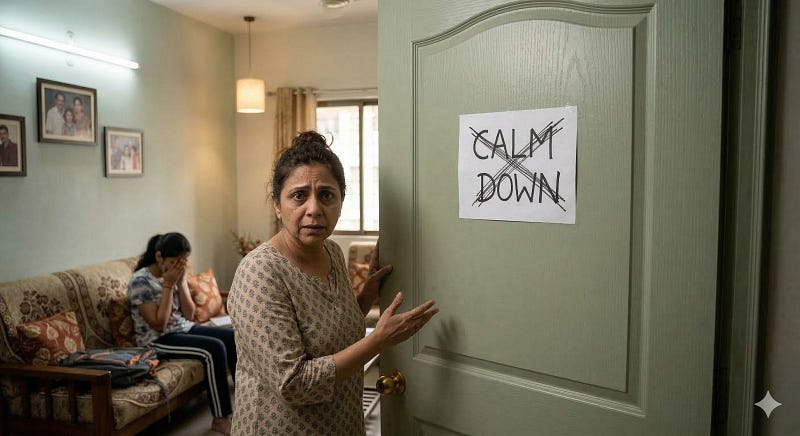
The scene: 9:47 PM on a school night.
Aarya storms into the living room, face red, voice cracking.
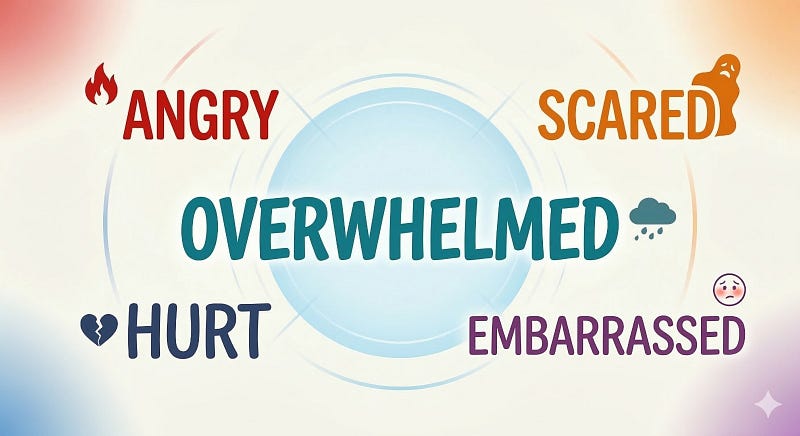
“I HATE her. I actually hate her. She told everyone. EVERYONE. And now the whole group thinks I am a liar and it’s NOT FAIR because I didn’t even DO anything, and she just ……..“
She is crying now. Words tumbling over each other. Hands shaking.
I do what any reasonable parent would do.
“Okay, okay, let’s calm down. Take a breath. Tell me what happened, slowly, from the beginning.”
She stares at me like I have just spoken in a foreign language.
“You are not LISTENING. I told you what happened! Why do you always do this? Why can’t you just …..”
“I AM listening. But I can’t help you if you are this worked up. Just calm down and …..”
“STOP TELLING ME TO CALM DOWN!”
She storms back to her room. Door slams. I am left standing in the living room, heart pounding, wondering what just happened.
· · ·
I did everything “right.”
I stayed calm. I asked for details. I tried to help her think through the situation logically.
And it made everything worse.
If you have ever watched your reasonable attempts to help your teenager backfire spectacularly, you are not alone. And you are not doing it wrong exactly ~ you are just doing it at the wrong time.
The problem isn’t your approach. It’s your timing.
You are trying to reach a brain that has temporarily gone offline.
· · ·
Why “Calm Down” Never Works
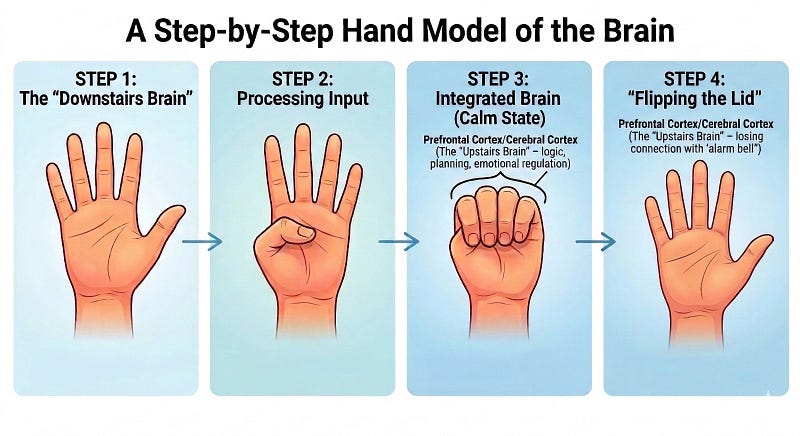
In Blog 3 of this series, I introduced you to the “flipping the lid” concept from Dr. Daniel Siegel’s Hand Model.
Quick recap: When emotions overwhelm the brain, the prefrontal cortex ~ the part responsible for logic, reasoning, and regulation ~ goes offline. The lid flips. The emotional brain takes over completely.
When your teenager is flooded with emotion, they are not being dramatic. They are not choosing to be unreasonable. They are experiencing a temporary state where the thinking part of their brain is simply not accessible.
This is why your logical approach fails:
· · ·
What you say: “Let’s think about this rationally.” What their brain hears: [Static. Nothing. The logic-processing center is offline.]
What you say: “It’s not that big a deal. You’ll feel better tomorrow.” What their brain hears: “Your feelings are wrong. You are overreacting.”
What you say: “Calm down and tell me what happened.” What their brain hears: “I can’t handle your emotions. Suppress them so I can be comfortable.”
What you say: “Here’s what you should do…” What their brain hears: [More static. They can’t process solutions right now.]
· · ·
You are speaking to the prefrontal cortex. But the prefrontal cortex isn’t home.
It’s like calling someone’s phone when the phone is switched off. You can keep calling. You can leave messages. But nobody’s going to answer until the phone is turned back on.
The lid has to come back down before logic can get through.
· · ·
The Emotional Spark: Why Teenage Feelings Are SO Big
Before we talk about what to do, let’s understand why teenage emotions are so intense in the first place.
In Blog 2, I introduced you to the ESSENCE of adolescence ~ the four key features of the teenage brain. The first one is ES: Emotional Spark.
During adolescence, the limbic system, the emotional center of the brain, is highly active. At the same time, the prefrontal cortex, which regulates emotions, is still under construction.
This creates a perfect storm:
Emotions are turned up. Regulation is turned down.
What does this feel like from the inside?
- A small disappointment feels like devastation
- A minor conflict feels like betrayal
- An embarrassing moment feels like social death
- A criticism feels like total rejection
- Excitement feels like electricity running through the body
- Anger feels like an explosion
These aren’t exaggerations. This is how the teenage brain actually processes emotional information.
· · ·
The 90-Second Rule
Here is something fascinating that neuroscientist Dr. Jill Bolte Taylor discovered:
The biological lifespan of an emotion is approximately 90 seconds.
When an emotion is triggered, a chemical process begins in the body. Stress hormones are released. The nervous system activates. The body responds.
From start to finish, if the emotion is allowed to move through without interference, this process takes about 90 seconds.
So why do teenage emotional storms last so much longer than 90 seconds?
Because something keeps retriggering the emotion:
- Their own thoughts (“I can’t believe she did that…”)
- Our responses (“You need to calm down…”)
- The situation is not being resolved
- Feeling unheard or dismissed
Every time the emotion gets retriggered, the 90-second clock resets.
When we tell them to “calm down,” we’re actually prolonging the storm, not ending it.

· · ·
What’s Happening in the Body
Here is where my training in Expressive Movement Therapy has completely changed how I approach emotional moments with Aarya.
Emotions don’t just happen in the brain. They happen in the body.
When your teenager is flooded with emotion, their entire nervous system is activated:
- Heart rate increases ~ they might feel their heart pounding
- Breathing becomes shallow and fast ~ less oxygen to the brain
- Muscles tense ~ especially jaw, shoulders, stomach, fists
- Digestion slows ~ that “pit in the stomach” feeling
- Stress hormones flood the system ~ cortisol, adrenaline
- The body prepares for fight or flight ~ even if there’s no physical danger
This is why you can see the emotion in their body: the clenched fists, the red face, the pacing, the inability to sit still.
The body is doing what it’s designed to do in response to perceived threat.
And here’s the crucial insight:
You cannot think your way out of a body state.
When the body is activated, the body needs to be addressed. Trying to use logic to calm a dysregulated nervous system is like trying to use words to lower a fever. The words aren’t the right tool for the job.
· · ·
Why This Changes Everything
Once I understood this, I stopped trying to reason with Aarya during emotional floods.
Instead, I started paying attention to her body, and to mine.
Because here is the other thing: Nervous systems communicate.
When your teenager is dysregulated, and you respond with your own tension, frustration, or anxiety, your nervous system adds fuel to their fire. They feel your stress, even if you are not yelling. They pick up on your clenched jaw, your tight voice, your forced “calm.”
But if you can genuinely regulate YOUR nervous system, slow your breathing, relax your shoulders, soften your voice, something remarkable happens:
Your calm can become their calm.
This is called co-regulation. And it’s one of the most powerful tools you have as a parent.

· · ·
What Actually Works: A Different Approach
Okay, so if “calm down” doesn’t work, and logic doesn’t work, and problem-solving doesn’t work…
What DOES work?
Here’s the counterintuitive approach that changed everything for me:
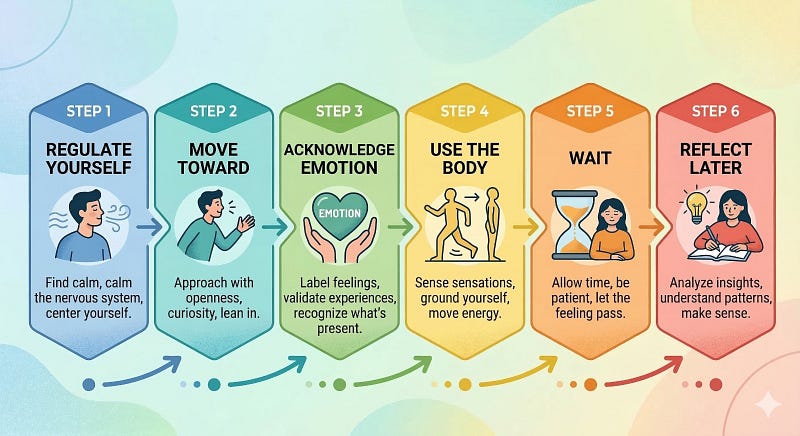
Step 1: Regulate Yourself First
Before you do anything else, check in with YOUR body.
- Is your heart racing?
- Is your jaw clenched?
- Are you holding your breath?
- Do you feel the urge to fix, lecture, or control?
If you are activated, you can’t help them regulate. You’ll just add to the chaos.
Take a breath. Feel your feet on the floor. Drop your shoulders.
This might take five seconds. It might take a minute. But it’s essential.
You are not being passive. You are becoming the anchor.
Step 2: Move Toward, Not Away
When someone is emotionally flooded, our instinct is often to create distance, either physically (leaving the room) or emotionally (becoming cold, logical, detached).
Resist this instinct.
Move toward them. Not aggressively. Not intrusively. Just… present.
This might look like:
- Sitting down near them (not too close)
- Staying in the room even if they are yelling
- Keeping your body language open
- Making yourself available without demanding
Your physical presence, calm, steady, non-threatening, communicates safety.
Step 3: Acknowledge, Don’t Analyze
This is the hardest part for most parents.
When your teenager is flooded, they don’t need you to understand the situation. They don’t need you to identify the problem. They don’t need solutions.
They need to feel felt.
This means acknowledging the emotion itself, not the facts of the situation.
Not: “So she told people something that wasn’t true?” Instead: “You are really hurt right now.”
Not: “Well, what exactly did she say?” Instead: “This feels like such a betrayal.”
Not: “Let’s figure out what to do.” Instead: “I can see how much this is affecting you.”
Notice: You are not agreeing with their interpretation. You are not validating that they are “right.” You are simply acknowledging that their emotional experience is real.
This is what Dr. Siegel calls “Name It to Tame It.”
When we put words to an emotion, something shifts in the brain. The very act of naming the feeling activates the prefrontal cortex and begins to calm the amygdala.
But, and this is crucial ~ YOU naming it works better than asking THEM to name it.
“What are you feeling?” requires them to access the thinking brain. That’s offline.
“You seem really angry. And hurt.” Does the work for them. It helps them feel seen without requiring them to think.
Step 4: Use the Body
Since the emotion is happening in the body, the body is often the fastest path to regulation.
Here are some options offered gently, not forced:
Movement:
- “Do you want to go for a walk?”
- “Let’s get out of this room for a minute.”
- “Can you shake your hands out? Sometimes that helps.”
Breath:
- “Take a breath with me.” (Then actually take a slow breath yourself; they’ll often mirror you)
- “Let’s breathe together for a second.”
Physical comfort (if welcome):
- A hand on the shoulder
- Sitting beside them
- Offering a blanket or pillow
Sensory regulation:
- “Here is some cold water.”
- “Splash some water on your face ~ it actually helps reset.”
- “Let’s step outside for fresh air.”
Important: These are offers, not commands. If they refuse, that’s okay. Just your calm presence is doing the work.
Step 5: Wait for the Lid to Come Back Down
This is the part that requires patience.
You have regulated yourself. You have moved toward them. You have acknowledged the emotion. You have offered body-based support.
Now… wait.
The storm will pass. It might take 5 minutes. It might take 30. But it will pass.
You’ll know the lid is coming back down when you see:
- Breathing slowing
- Body unclenching
- Voice softening
- Eye contact returning
- The ability to have a back-and-forth conversation
Only THEN do you shift to problem-solving, logic, or discussion.
“Okay. Now that we are both calmer… do you want to tell me what happened? Or do you want to just leave it for now?”
Give them a choice. They might not want to process it right away. That’s fine. The connection has been maintained. The conversation can happen later.
Step 6: Later ~ Reflect and Repair
Once the storm has fully passed, maybe hours later, maybe the next day, you can revisit:
“That was a tough moment last night. How are you feeling now?”
“I noticed I got frustrated, too. I am sorry if that didn’t help.”
“Is there anything you want to talk about? Or anything you need from me?”
This is where learning happens. This is where patterns can be discussed, skills can be built, and relationships can be strengthened.
But NOT during the flood. After.
· · ·
What About Indian Families?
I need to address something specific to our cultural context.
In many Indian families, emotions ~ especially big, messy, inconvenient emotions – are not welcome.
The messages we absorb:
- “Don’t cry. Be strong.”
- “Control yourself. What will people think?”
- “Don’t make a scene.”
- “Anger is disrespectful.”
- “You are being too sensitive.”
We learn to suppress. We learn that emotions are problems to be solved, not experiences to be felt. We learn that a “good child” is a calm, controlled, unexpressive child.
And then we become parents. And when OUR children have big emotions, our first instinct is to make it stop. Not because we don’t care, but because we were never taught that emotions are okay.
· · ·
Here is what I want you to consider:
Your teenager’s emotional intensity is not a problem to be solved. It’s an experience to be witnessed.
They are not being dramatic. They are not being disrespectful. They are not being “too much.”
They are being human. And their brain is amplifying that humanity right now.
When we shut down their emotions, we don’t teach them to be strong. We teach them to hide. We teach them that parts of themselves are unacceptable. We teach them to regulate alone, which often means they don’t learn to regulate at all.
But when we stay present through their storms, we teach them something different:
“All of you is welcome here. Even the messy parts. Even the loud parts. I can handle it. You can handle it. Let’s move through it together.”
That’s not permissive parenting. That’s teaching regulation through relationship.
· · ·
When YOUR Lid Flips Too
Let’s be real: Sometimes you can’t stay calm.
Sometimes their emotion triggers YOUR emotion. Sometimes you flip your lid, too. Sometimes you yell back, say something you regret, or storm off yourself.
This happens. You are human.
What matters is what you do next.
· · ·
The Power of Repair
Dr. Siegel emphasizes that ruptures in connection are inevitable, but repair is what builds resilience.
When you have lost your temper, when you have handled it badly, when you have made things worse:
Name it. Own it. Repair it.
“I lost my temper last night. I am sorry. That wasn’t helpful.”
“I said some things I didn’t mean. That wasn’t fair to you.”
“I got overwhelmed, too. I wish I’d handled that differently.”
This isn’t a weakness. This is modeling.
When you repair, you teach your teenager:
- Adults make mistakes, too
- Emotions can overwhelm anyone
- Relationships can survive rupture
- Taking responsibility is what strong people do
Repair is not failure. Repair is how relationships get stronger.
· · ·
A Story from BECOMING
At our BECOMING retreats, we create space for teenagers to experience big emotions safely, often for the first time.
One evening, a 15-year-old girl ~ let’s call her Priya – became overwhelmed during a group exercise about family relationships. Tears came. Then anger. Then what looked like panic.
The other teens looked uncomfortable. Some wanted to fix it. Some wanted to distract her. Some wanted to leave.
Our facilitators did something different.
One sat near her. Not touching. Just present.
“You are safe here. Take your time.”
Another gently guided the rest of the group to give space without abandoning.
“Let’s all take a breath together. Priya’s having a hard moment. She’s okay. We are all here.”
For about ten minutes, Priya cried. Hard. The kind of crying that comes from somewhere deep.
And then… it passed. Her breathing slowed. Her shoulders dropped. She looked up.
“I have never cried like that in front of people before,” she said. “I always go to my room and do it alone.”
“How did it feel to have people here with you?” the facilitator asked.
She thought about it. “Scary. But also… like I wasn’t crazy. Like it was okay to feel that much.”
Later, Priya told me something that stuck with me:
“At home, when I get upset, everyone tries to calm me down. It makes me feel like I am too much. Here, you just let me feel it. And it actually went away faster.”
Sometimes the most powerful thing we can do is simply stay.

· · ·
Five Things You Can Do This Week
1. Practice regulating yourself first
Before your teenager has their next emotional moment, practice with smaller triggers.
When you feel frustration rising—maybe in traffic, maybe at work—practice:
- Three slow breaths
- Dropping your shoulders
- Feeling your feet on the floor
Build this muscle in low-stakes moments so it’s available in high-stakes ones.
2. Drop “calm down” from your vocabulary
This week, notice every time you are tempted to say “calm down,” “relax,” or “it’s not a big deal.”
Replace with:
- “I can see you are really upset.”
- “This is hard.”
- “I am here.”
3. Practice “Name It to Tame It.”
The next time your teenager is flooded, try naming what you see:
- “You seem really angry right now.”
- “That sounds incredibly frustrating.”
- “I can see how hurt you are.”
Don’t ask them to name it. Name it for them. Then wait.
4. Offer one body-based option
Instead of talking through the emotion, try offering one physical intervention:
- “Want to go for a walk?”
- “Take a breath with me.”
- “Let’s step outside for a minute.”
Notice if it helps them settle faster than conversation.
5. Repair one rupture
Think back to a recent moment when you didn’t handle their emotions well.
Go to them and say: “I have been thinking about [that moment]. I don’t think I handled it well. I am sorry.”
You don’t need to fix anything. Just acknowledge and repair.
· · ·
What’s Coming Next
We have covered what to do when emotions flood. But there’s a deeper pattern happening that confuses every parent:
Why does your teenager push you away when they need you most?
In Blog 7, we’ll explore the painful paradox:
“They are Pushing You Away Because They Need You to Stay”
You’ll know why the push-pull isn’t rejection, it’s testing. And how to pass the test without losing yourself.
· · ·
Join our WhatsApp community to get the next blog delivered directly to your phone ~ plus connect with other parents navigating the teenage years.
Preeti Toraskar is the founder of Young SoulTales, where children’s emotional development is the curriculum. She’s currently completing her Master’s in Expressive Movement Therapy, has trained with Dr. Daniel Siegel, and is the mother of a 14-year-old Aarya
