

Whole-Brain Strategy #10: SIFT Through the Mind
“What’s wrong?”
“I don’t know.”
“Why are you upset?”
“I don’t KNOW.”
This isn’t defiance. It’s not avoidance. Most of the time, when children say they don’t know what they’re feeling, they genuinely don’t know.
Their inner world is a jumble ~ sensations, memories, emotions, thoughts all swirling together. Asking “what’s wrong?” is like asking someone to describe a painting while they’re standing too close to see it.
They need a way to step back. To sort through the swirl. To understand what’s actually happening inside.
That’s what SIFT does.
· · ·
The SIFT Tool: A Flashlight for the Inner World
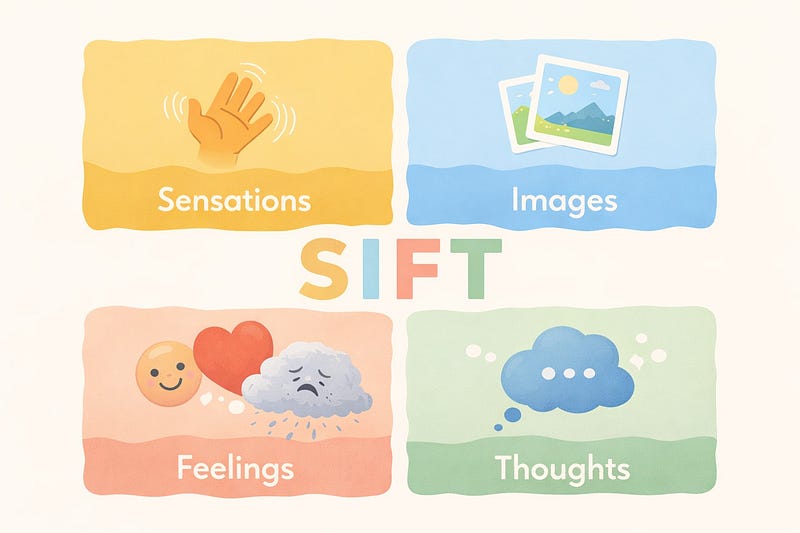
In The Whole-Brain Child, Dr. Daniel Siegel introduces SIFT as a way to help children (and adults) explore their inner experience:
S—Sensations What’s happening in your body? Tight chest? Clenched jaw? Butterflies in stomach? Heavy limbs? Racing heart?
I—Images What pictures or memories are coming up? A scene from school? Someone’s face? A moment from the past? Sometimes our minds show us images connected to our emotional state.
F—Feelings What emotions can you name? Sad? Angry? Scared? Embarrassed? Sometimes there are multiple feelings layered together.
T—Thoughts What’s going through your mind? “Nobody likes me.” “I’m going to fail.” “This isn’t fair.” “I can’t do this.”
When we SIFT through our experience, we take a chaotic inner state and make it understandable. We shine a light into the darkness and see what’s actually there.
This is the opposite of “just tell me what’s wrong.”
Instead of asking children to immediately produce an answer, SIFT gives them a process. A way to investigate. A flashlight for the dark.
· · ·
Why Children (and Adults) Don’t Know What They Feel
Here’s something that surprised me when I first learned it:
Emotional awareness is a skill, not a given.
We assume that people automatically know what they’re feeling. That emotions come pre-labelled. That everyone has equal access to their inner world.
They don’t.
Some children are naturally more attuned to their internal experience. Others are almost entirely externally focused ~ aware of what’s happening around them, but blind to what’s happening inside.
Neither is better or worse. But children who can’t access their inner world struggle to:
- Regulate their emotions (you can’t manage what you can’t see)
- Communicate their needs
- Understand their reactions
- Make sense of their experiences
SIFT builds this skill. It teaches children HOW to look inside. And like any skill, it gets stronger with practice.
· · ·
The Indian Disconnect

In many Indian households, there’s enormous attention paid to external development:
- Academic performance
- Extracurricular achievements
- Social behaviour
- Physical health
But internal development ~ understanding one’s own mind, emotions, patterns is often neglected. Not because parents don’t care, but because we weren’t taught this ourselves.
How many of us grew up with parents who asked: “What sensations are you noticing in your body right now?”
For most of us, the answer is zero.
We learned to perform, to achieve, to behave appropriately. We didn’t learn to SIFT through our inner experience.
The result? Adults who are successful externally but disconnected internally. Who feel things intensely but can’t name them. Who react but don’t understand why.
We can give our children something different.
Not instead of achievement ~ alongside it. The ability to know themselves from the inside out.
· · ·
Teaching SIFT: Start With the Body
Here’s a secret about SIFT:
Start with Sensations. Always.
The body is the easiest entry point. It’s concrete. Observable. Children can point to where they feel things.
“Where in your body do you notice something right now?”
This question does something powerful: it redirects attention from the swirling chaos of the mind to the solid ground of physical sensation.
A child might say:
- “My tummy feels tight”
- “My head hurts”
- “My hands are shaky”
- “I feel heavy all over”
They might not be able to name the emotion yet. But they can notice the body. And the body is always connected to emotion.
Once you’ve anchored in sensation, the other elements become easier to access.
· · ·
How to Walk Through SIFT With Your Child
When They’re Calm (Practice Mode)
Don’t introduce SIFT during a crisis. Teach it when things are stable.
“I want to show you something cool—a way to understand what’s happening inside you. It’s called SIFT. Want to try?”
Start with RIGHT NOW, when nothing is particularly wrong:
Sensations: “Close your eyes. Notice your body. What do you feel? Any tension? Any comfort? What’s happening in your stomach? Your shoulders?”
Images: “Now notice if any pictures or memories are floating through your mind. It’s okay if there aren’t any.”
Feelings: “What emotion would you name right now? Calm? Happy? A little tired? Bored?”
Thoughts: “What thoughts are passing through? Maybe ‘this is weird’ or ‘I’m hungry’ or ‘I wonder what’s for dinner’?”
Make it playful. Make it curious. Not an interrogation—an exploration.
When They’re Struggling (Application Mode)
Once they know the tool, you can use it during difficult moments:
“I can see something’s going on. Can we SIFT through it together?”
Start with body: “Let’s start with your body. Put your hand where you feel something. What’s it like? Tight? Heavy? Buzzy?”
Then images: “Is there a picture coming up? Something that happened? Someone’s face?”
Then feelings: “If you had to name a feeling—even a guess—what would it be?”
Then thoughts: “What’s your mind telling you right now?”
Sometimes, just the process of SIFTing shifts the state. The act of observing creates distance. The chaos becomes ordered.
When They Resist
Some children won’t want to SIFT. That’s okay.
You can do it aloud yourself: “I’m going to SIFT through what I’M noticing. My chest feels tight… I keep seeing that moment in the car… I think I’m feeling frustrated… My thought is ‘this isn’t going how I wanted.’”
Modeling is teaching. They’re absorbing it even when they won’t participate.
· · ·
Age-Specific Approaches
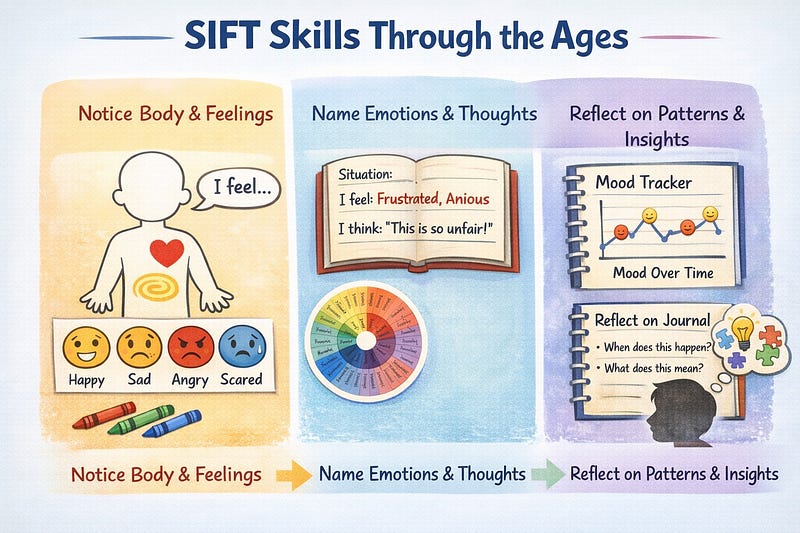
Young Children (5–8)
Keep it simple. Focus mostly on Sensations and Feelings.
- Use a body outline drawing ~ “colour where you feel something”
- Use feeling faces ~ “point to the face that matches”
- Use simple sensation words: tight, loose, heavy, light, hot, cold, buzzy, calm
- Images might be hard ~ skip or simplify: “Is there something you keep thinking about?”
Make it a game, not homework. “Let’s do a body scan! Start at your toes…”
Middle Childhood (8–12)
Children this age can engage with all four elements:
- Introduce a wider vocabulary of emotions (not just happy/sad/angry)
- Help them notice that sensations CONNECT to feelings (“When you feel nervous, where does your body feel it?”)
- Images become more accessible ~ memories, mental pictures, even imagination
- Thoughts can be explored: “What’s the story your mind is telling about this?”
This is a great age for journaling. Some children prefer writing to talking.
Teenagers (13–17)
Teens can use SIFT as a sophisticated self-awareness tool:
- Explore patterns: “You’ve SIFTed a few times when anxious. Do you notice similarities?”
- Discuss the difference between thoughts and facts
- Use SIFT for decision-making: “Let’s SIFT through how you feel about this choice”
- Encourage independent use: “Want to take a few minutes to SIFT before we talk?”
Aarya has started doing something that amazes me ~ she’ll sometimes say, mid-conversation, “Wait, I need to figure out what I’m actually feeling.” That’s SIFT, internalized. She doesn’t call it that. She doesn’t go through each letter. But the skill is there.
· · ·
What We Do at Young SoulTales
At our retreats, SIFT isn’t a one-time lesson ~ it’s woven throughout.
Morning check-ins often include a quick body scan: “Close your eyes. Notice what’s happening in your body this morning. No need to change it, just notice.”
After activities, especially challenging ones, we pause: “Let’s SIFT through that experience. What sensations came up? Any images or memories? Feelings? Thoughts?”
This teaches children that reflection is normal. That pausing to understand yourself is valuable. That the inner world deserves the same attention as the outer world.
I remember one boy at a Roots & Wings camp ~ maybe 9 years old ~ who kept getting into conflicts with other children. Every little thing set him off. The other facilitators and I were struggling to help him.
On Day 2, we tried SIFT with him during a calm moment. Just curious exploration.
Sensations: He noticed his jaw was always clenched. Always. He’d never realized.
Images: He kept seeing his older brother’s face. The brother who teased him constantly at home.
Feelings: He named it: “Mad. I’m always a little bit mad.”
Thoughts: “Everyone’s going to make fun of me.”
Suddenly, his behaviour made sense. He wasn’t randomly aggressive. He was walking around braced for attack ~ body clenched, mind ready for mockery, because that was his experience at home.
We didn’t “fix” him. But something shifted. He had language for what was happening inside. And over the next two days, when he started to escalate, a gentle “what’s your jaw doing right now?” would help him catch himself.
SIFT gave him a flashlight. He could finally see what was driving him.
· · ·
The Gift of Self-Knowledge
Here’s why SIFT matters beyond just handling difficult moments:
Children who can SIFT through their experience develop self-knowledge.
They learn:
- What situations trigger them
- How emotions show up in their body
- What thoughts patterns they have
- What memories are still affecting them
This self-knowledge is foundational. It’s the basis of emotional intelligence. Of healthy relationships. Of conscious decision-making.
A child who knows themselves can answer questions like:
- “Why did I react that way?”
- “What do I actually need right now?”
- “What’s driving my behaviour?”
And they can do something radical: they can CHOOSE how to respond instead of just reacting.
· · ·
This Works for Us Too
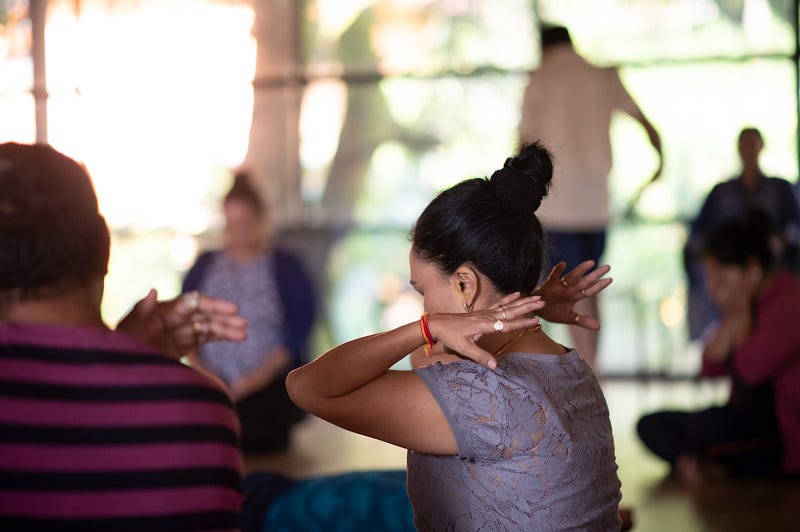
When did you last SIFT through your own experience?
Most of us react to our inner states without examining them. We feel anxious and immediately try to fix it. We feel angry and either explode or suppress. We feel sad and distract ourselves.
What if you got curious instead?
Try this the next time you’re in a strong emotional state:
S: Pause. Scan your body. Where do you feel this? What quality does it have?
I: Notice what images or memories are present. What scene keeps replaying? Whose face do you see?
F: Name the feelings. Not just one ~ often there are layers. Angry on top, hurt underneath. Frustrated on the surface, scared beneath.
T: What thoughts are running? What story is your mind telling? What beliefs are activated?
Just this process ~ taking 60 seconds to SIFT ~ often shifts something. You’re no longer lost in the experience. You’re observing it. And observation creates choice.
When your children see you SIFTing ~ “Hold on, I need to figure out what I’m feeling right now… okay, my chest is tight, I keep thinking about that email, I think I’m anxious about the response…” ~ you’re teaching them that adults do this too. That self-knowledge is a lifelong practice.
· · ·
What’s Next
In the next post, we’ll explore Strategy #11: Exercise Mindsight ~ bringing together everything we’ve learned about observing the mind and using that awareness to return to calm when overwhelmed.
If SIFT is the flashlight, Mindsight is learning to use that flashlight skillfully in the dark.
If you’re following this series on WhatsApp, you’ll get it directly on Friday.
👉 Join the Young SoulTales Parent’s Circle ~ We share these strategies, real stories from our retreats, and tools for raising emotionally intelligent children.
· · ·
Preeti Toraskar is the founder of Young SoulTales, where children’s emotional development is the curriculum. She’s currently completing her Master’s in Expressive Movement Therapy, has trained with Dr. Daniel Siegel, and is the mother of a 14-year-old who occasionally announces “I need to figure out what I’m actually feeling”~and nothing makes a parent prouder.
· · ·
Previous: Strategy #9 ~ Let the Clouds Roll By: Teaching That Emotions Are Temporary → Next: Strategy #11 ~ Exercise Mindsight (Coming Tuesday)
