

Whole-Brain Strategy #11: Exercise Mindsight
You’ve probably seen it happen:
Your child is overwhelmed. Completely flooded. Tears, anger, panic ~ they’re drowning in emotion and can’t find their way out.
You try to reason with them. It doesn’t work. You try to comfort them. They push you away. You try to fix it. They get more upset.
In that moment, it feels like there’s nothing you can do. Like you just have to wait for the storm to pass.
But what if your child had a skill ~ practiced and available ~ that could help them find their way back to calm? Not by suppressing the emotion. Not by being rescued by you. But by using their own mind to observe what’s happening and gently return to shore.
That’s mindsight.
· · ·
What Is Mindsight?
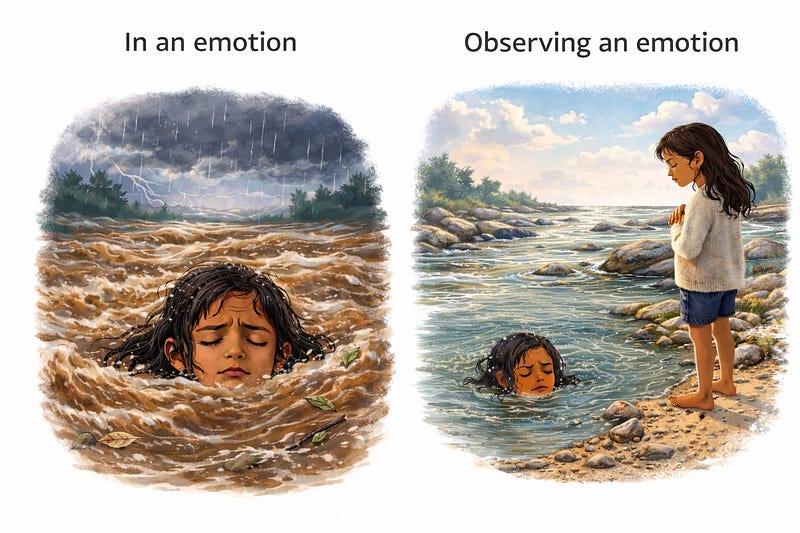
Dr. Daniel Siegel coined the term “mindsight” to describe a powerful capacity:
The ability to see your own mind.
It sounds simple. It’s not.
When we’re overwhelmed by emotion, we don’t have perspective on it. We ARE the emotion. There’s no separation between the feeling and the self. We’re drowning, and we can’t see the water.
Mindsight is the ability to step back ~ even slightly and observe what’s happening. To notice: “I’m having a big feeling right now. My body is tense. My thoughts are racing. I’m overwhelmed.”
That tiny bit of distance changes everything.
It doesn’t make the feeling disappear. But it creates space. And in that space, choice becomes possible.
Without mindsight: The emotion happens TO you. You’re helpless. With mindsight: You can observe the emotion. You have options.
This is what we’ve been building toward in this entire series. Connect and redirect. Name it to tame it. SIFT. Clouds rolling by. All of these strategies develop mindsight ~ the capacity to see your own mind and work with it skillfully.
“Exercise Mindsight” is about putting it all together when it matters most: in the moments of overwhelm.
· · ·
The Wheel of Awareness
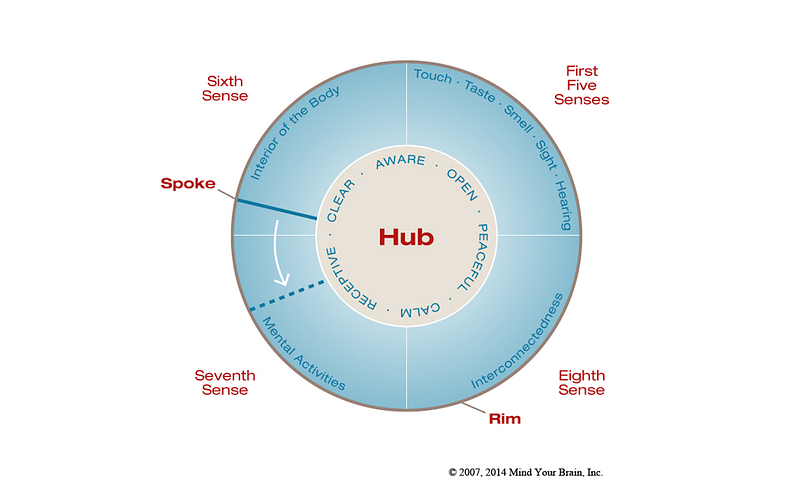
Dr. Siegel uses a powerful metaphor for mindsight: the Wheel of Awareness.
Imagine a bicycle wheel.
The hub at the center represents your core self ~ the calm, observing part of you that remains constant.
The rim represents everything you might pay attention to: sensations in your body, images in your mind, feelings, thoughts, memories, perceptions of the outside world.
The spokes are your attention ~ how you direct your focus from the hub to different points on the rim.
When we’re overwhelmed, we get stuck on one point of the rim. Maybe it’s a racing thought: “I’m going to fail.” Maybe it’s a physical sensation: tightness in the chest. Maybe it’s a feeling: pure rage.
We forget that there’s a whole rim of experiences. And we forget entirely about the hub ~ the calm center from which we can observe.
Exercising mindsight means returning to the hub.
It means remembering: “I am not this thought. I am not this sensation. I am the one who is aware of them. And from this center, I can choose where to direct my attention.”
· · ·
Why This Is Hard for Children (And Most Adults)
Let’s be honest: this is an advanced skill.
Most adults can’t do this reliably. We get hijacked by emotions all the time. We lose perspective. We say things we regret. We act from reaction rather than response.
So how can we expect children to do it?
We can’t ~ not perfectly, not consistently. But we can:
- Teach the concept so they have language for what’s possible
- Practice during calm times so the neural pathways exist
- Offer gentle reminders during difficult moments
- Model it ourselves so they see it in action
Mindsight isn’t about being perfect. It’s about having a way back when you’re lost.
Even if your child can access mindsight 10% of the time they’re overwhelmed, that’s transformative. And the percentage grows with practice.
· · ·
The Indian Context: Discipline vs. Self-Regulation
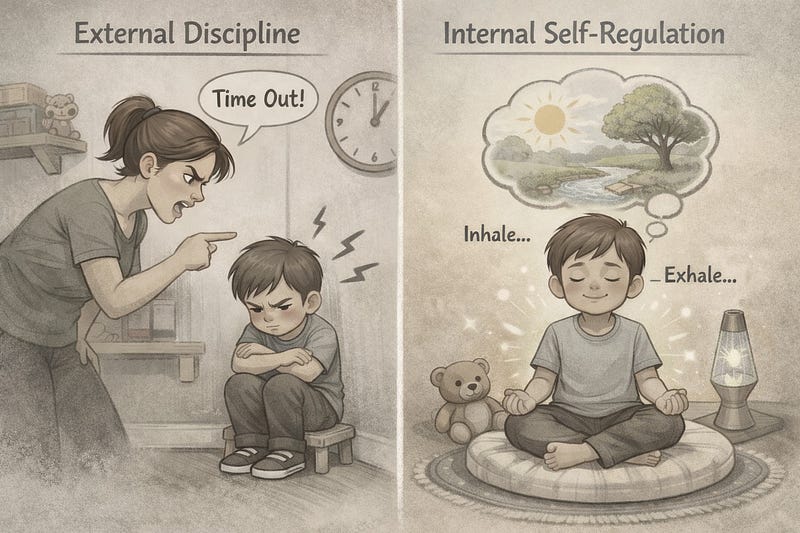
In traditional Indian parenting, emotional regulation often came from outside the child:
“Stop crying or I’ll give you something to cry about.” “Control yourself.” “Behave properly.”
The message: regulate your emotions because I’m telling you to. Because there are consequences if you don’t. Because it’s inappropriate to feel this way.
This creates external compliance. It doesn’t build internal capacity.
A child who stops crying because they’ll be punished hasn’t learned to regulate. They’ve learned to suppress. The emotion goes underground, not away.
Mindsight is the opposite approach.
It’s not: “Stop feeling this way.” It’s: “Notice what you’re feeling. Observe it. Find your way back to center.”
The regulation comes from inside ~ from the child’s own awareness and capacity.
This isn’t permissive. We still have boundaries. We still guide behaviour. But we’re building a human who can eventually regulate themselves, not one who needs external control forever.
· · ·
How to Teach Mindsight to Children
Start With the Hub
The first step is helping children experience their “hub” ~ that calm, centered place that exists underneath all the emotional weather.
Try this practice when your child is calm:
“Let’s find your calm center. Close your eyes. Take three slow breaths. Now imagine you’re in the very center of a wheel ~ a quiet, still place. All around the edge of the wheel are different things: thoughts, feelings, sounds, sensations. But you’re in the center, just noticing them. Not chasing them. Just aware.”
This doesn’t have to be elaborate. Even 30 seconds of “finding the center” builds the neural pathway.
With younger children, you might use different language:
“Let’s find your quiet inside. Close your eyes. Breathe slowly. Can you find the part of you that’s just watching? Just noticing? That’s your quiet place. It’s always there, even when feelings are big.”
Practice Moving Attention
Once children can find the hub, practice moving attention intentionally:
“From your quiet center, notice your feet. What do they feel like? Now notice your breathing. Now notice any sounds in the room. See how you can move your attention to different things? That’s your superpower. You get to choose where you focus.”
This teaches a crucial skill: attention is movable. We’re not stuck looking at one thing forever.
Name What’s Happening
During calm times, practice narrating internal experience:
“Right now, I notice I’m feeling a little tired. My shoulders are tight. My mind is thinking about what’s for dinner. I’m going to take a breath and come back to this moment.”
When children hear you doing this, they learn that observing your own mind is normal. That adults do it. That it’s a skill, not a magic ability.
Create a Cue
Develop a simple cue your child can use (or you can offer) during overwhelm:
- A word: “Hub” or “Center” or “Breathe”
- A gesture: Hand on heart, or a specific breathing pattern
- A question: “Where’s your quiet place right now?”
The cue isn’t magic. But if it’s been practiced during calm times, it can serve as a bridge during storms. It reminds them: there’s another way to be with this.
· · ·
Age-Specific Approaches
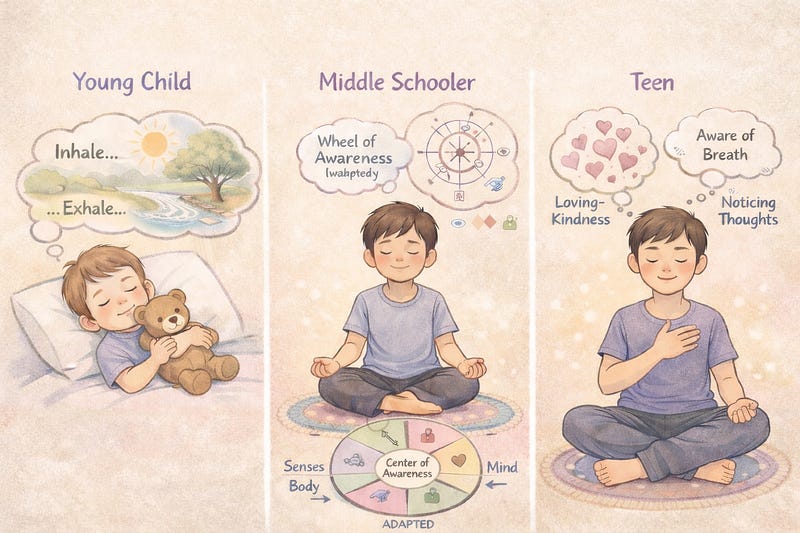
Young Children (5–8)
Keep it concrete and playful:
- Breathing buddy: A stuffed animal on their belly that rises and falls with breath. Focusing on the animal’s movement is a mindsight practice.
- Glitter jar: A jar filled with water and glitter. Shake it (the overwhelm) and watch the glitter settle (the return to calm). “Your mind is like this jar.”
- “Where’s your calm?”: A simple question that directs attention inward.
Don’t expect them to access this during full meltdowns. But afterwards, you can reflect: “Remember when you were so upset? And then you found your calm? You did that.”
Middle Childhood (8–12)
Children this age can engage more directly:
- Introduce the wheel concept: Draw it together. Label different things on the rim.
- Practice “returning to hub”: Regular brief practices (even 1 minute) build capacity.
- Create personal cues: Let them choose their own word or gesture.
- Reflect after difficult moments: “What helped you come back to calm? What could you try next time?”
Teenagers (13–17)
Teens can engage with mindsight philosophically:
- Discuss the observer: “Who’s the one noticing your thoughts? Is that ‘you’?”
- Explore meditation apps: Many teens find guided practices helpful (without calling it “meditation” if that feels uncool)
- Journal prompts: “Describe a recent moment of overwhelm from the perspective of an observer watching you”
- Normalize the struggle: “Even adults lose mindsight. The goal isn’t perfection ~ it’s having a way back.”
Aarya has her own version of this. When she’s really overwhelmed, she sometimes says, “I need to go to my room.” And she emerges 20 minutes later, calmer, having done… something. Breathed. Listened to music. Written. I don’t always know what. But she’s learned that she can find her way back. She has a hub, and she knows how to get there.
· · ·
What We Do at Young SoulTales
At our retreats, mindsight isn’t a single activity ~ it’s embedded in everything we do.
Morning centering: Each day begins with a few minutes of finding the quiet inside. We don’t call it meditation (that word carries baggage). We call it “arriving.” Arriving in your body. Arriving in this day. Finding your center before the activities begin.
After challenges: When children face difficult moments ~ social conflicts, physical challenges, emotional triggers ~ we pause afterwards to reflect. “Where did you go when that was hard? Did you find your calm? What helped?”
Breathing practices: We teach simple breathwork that children can use anywhere. Box breathing. Counted exhales. Nothing complicated. Tools they can carry with them.
The return ritual: At the end of each day, we do a brief “return to center” practice. Whatever happened during the day ~ exciting, frustrating, joyful, confusing ~ we end in the same place: the hub.
I remember one girl at a BECOMING retreat who struggled with anxiety. She’d been told her whole life to “calm down” ~ which only made her more anxious. She felt broken, like everyone else could stay calm and she couldn’t.
When we introduced mindsight, something shifted.
“I’m not supposed to NOT feel anxious,” she said on Day 2. “I’m supposed to notice that I’m feeling anxious. That’s different.”
Exactly.
She still felt anxious. But she wasn’t drowning in it anymore. She had a way to observe it and from that observation, she discovered she could find her way back to shore.
On the last day, she told the group: “I think my anxiety will always be part of me. But now I know it’s not ALL of me.”
That’s mindsight.
· · ·
This Works for Us Too
When did you last lose mindsight?
Maybe you snapped at someone and only realized later what happened. Maybe you spiraled into worry and couldn’t stop. Maybe you got so angry you said things you regretted.
We all lose it. The question is: do we have a way back?
Try this:
The next time you notice yourself getting overwhelmed ~ heart racing, thoughts spinning, emotions flooding ~ try this:
- Pause. Even one second of pause creates space.
- Name it: “I’m getting overwhelmed right now.”
- Find the hub: Take one conscious breath. Feel your feet on the ground. Remember: you are the one who is aware of all this. You are not the chaos, you’re the one witnessing it.
- Choose: From this tiny bit of distance, choose your next action. It doesn’t have to be perfect. Just chosen rather than automatic.
And when your children see you doing this ~ “Hang on, I’m getting overwhelmed, I need to find my center…” ~ you’re teaching them more than any lecture ever could.
You’re showing them: adults get overwhelmed too. And adults have ways back.
· · ·
What’s Next
In the final post of this series, we’ll explore Strategy #12: Connect Through Conflict ~ teaching children to fight with a “we” in mind. Because conflict is inevitable. But how we handle it shapes our relationships forever.
This one is especially important for Indian families, where conflict is often either explosive or completely avoided. There’s a better way.
If you’re following this series on WhatsApp, you’ll get it directly on Tuesday.
👉 Join the Young SoulTales Parent’s Circle ~ We share these strategies, real stories from our retreats, and tools for raising emotionally intelligent children.
· · ·
Preeti Toraskar is the founder of Young SoulTales, where children’s emotional development is the curriculum. She’s currently completing her Master’s in Expressive Movement Therapy, has trained with Dr. Daniel Siegel, and is the mother of a 14-year-old who has learned to say “I need to go to my room” ~ and emerges calmer, having found her own way back.
· · ·
← Previous: Strategy #10 ~ SIFT: A Flashlight for the Inner World → Next: Strategy #12 ~ Connect Through Conflict: The Final Strategy (Coming Friday)
