
Whole-Brain Strategy #2: Name It to Tame It

In the first post of this series, I told you about Aarya and the moon.
When she was little, she was terrified of it. Not the dark but the moon itself. She’d look up at the night sky and her whole body would tense. “What Aarya is scared about—Moon,” (she’d announce, in that third-person way toddlers sometimes speak).
And I did what most parents do.
I reassured. I explained. I reasoned.
“The moon is so beautiful, baby. It’s so far away and it can’t hurt you. See? It’s just light. There’s nothing to be scared of.”
Logical. Comforting. Completely ineffective.
Her fear didn’t go away because I explained it away. It just went underground. She stopped talking about it, but I don’t know if she ever truly felt safe with the night sky or if she just learned that her fear wasn’t welcome in conversation.
What I didn’t know then, what I wish someone had told me, was that I had it backwards.
I was trying to make the fear disappear. What I should have done was help her tell the story of the fear.
· · ·
The Science: Why Naming Emotions Calms the Brain
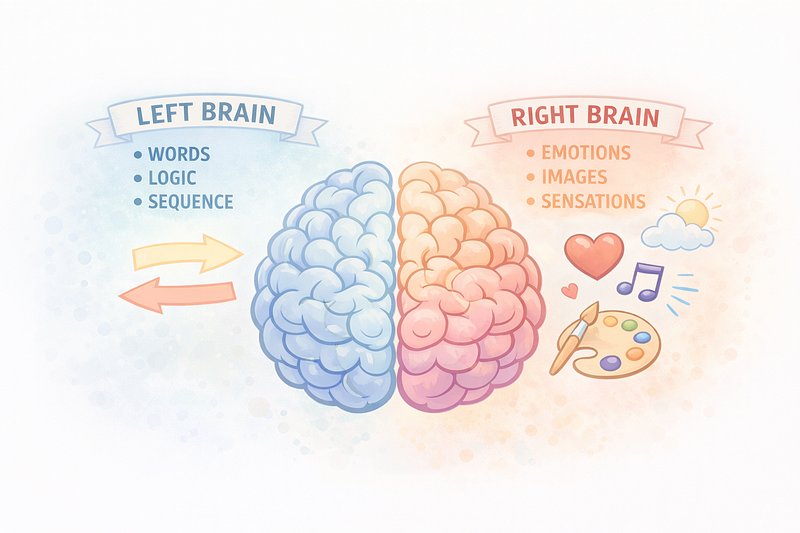
Here is something remarkable that neuroscience has revealed:
When we put a name to what we’re feeling, the emotional circuitry in the brain literally calms down.
This isn’t metaphor. It’s measurable. Brain imaging studies show that when people label their emotions, “I feel scared,” “I feel angry,” “I feel sad”, the activity in the amygdala (the brain’s alarm system) decreases. The simple act of putting words to feelings shifts activity from the reactive right brain to the more regulated left brain.
For children, this is even more powerful, because their brains are still developing the connections between the emotional right hemisphere and the logical left hemisphere.
When your child is overwhelmed by big feelings, their right brain is flooded. The emotions feel endless, shapeless, all-consuming. They don’t have the words to understand what’s happening inside them. And without words, the feelings just… stay. Spinning. Overwhelming. Controlling.
But when you help them tell the story of what happened, when you help them put words and sequence to the experience then something shifts.
The left brain comes online. The two hemispheres start working together. The emotion that felt infinite a moment ago now has a beginning, a middle, and the most importantly is an end.
That’s why the strategy is called “Name It to Tame It.”
When children can name what they feel, they can begin to tame it. Not suppress it. Not ignore it. Tame it—meaning it no longer controls them.
· · ·
What I Should Have Done With Aarya
Looking back, I can see exactly where I went wrong with the moon fear.
Aarya’s right brain was full of something, an image, a sensation, a feeling she couldn’t articulate. The moon meant something scary to her. Maybe it looked too big. Maybe it followed her when we drove at night. Maybe she’d seen something in a book or a dream. I don’t know, because I never asked.
Instead of exploring her fear, I tried to erase it.
“There’s nothing to be scared of” is a left-brain statement. It’s logic. It’s reason. And to a flooded right brain, it sounds like: Your feelings don’t make sense. Stop having them.
What I should have done was help her tell the story.
I could have said:
“You’re looking at the moon and something feels scary. Tell me about it.”
“What does the moon do that feels scary?”
“When did you first feel scared of the moon? Can you remember?”
“What does the scared feeling feel like in your body? Is it in your tummy? Your chest?”
And then this is the important part where I could have helped her build a narrative around it:
“So sometimes when you see the moon, your tummy feels tight and you feel scared. And you’ve felt like that since… do you remember? Maybe that night when we were driving and the moon looked really big? And now every time you see it, your body remembers that feeling.”
Just naming it. Putting it into a story. Giving her brain something to hold onto, instead of being swept away by formless fear.
I didn’t do this. I wish I had.
· · ·
Here’s something remarkable that neuroscience has revealed:
When we put a name to what we’re feeling, the emotional circuitry in the brain literally calms down.
This isn’t metaphor. It’s measurable. Brain imaging studies show that when people label their emotions, “I feel scared,” “I feel angry,” “I feel sad” then the activity in the amygdala (the brain’s alarm system) decreases. The simple act of putting words to feelings shifts activity from the reactive right brain to the more regulated left brain.
For children, this is even more powerful because their brains are still developing the connections between the emotional right hemisphere and the logical left hemisphere.
When your child is overwhelmed by big feelings, their right brain is flooded. The emotions feel endless, shapeless, all-consuming. They don’t have the words to understand what’s happening inside them. And without words, the feelings just… stay. Spinning. Overwhelming. Controlling.
But when you help them tell the story of what happened, when you help them put words and sequence to the experience then something shifts.
The left brain comes online. The two hemispheres start working together. The emotion that felt infinite a moment ago now has a beginning, a middle, and most importantly at the end.
That’s why the strategy is called “Name It to Tame It.”
When children can name what they feel, they can begin to tame it. Not suppress it. Not ignore it. Tame it—meaning it no longer controls them.
· · ·
How “Name It to Tame It” Works in Practice
Let me give you some real examples of what this looks like.
Example 1: The Fear That Won’t Flush
There’s a story in The Whole-Brain Child about a nine-year-old named Bella who became terrified of flushing the toilet after seeing it overflow once. The water rising, spilling onto the floor, the memory lived in her body. She couldn’t flush anymore without feeling that same panic.
Her father didn’t try to convince her the fear was irrational. Instead, he sat with her and retold the story.
“Remember the day the toilet overflowed? Let’s talk about it. You flushed, and then what happened?”
He let her describe the water rising. The fear she felt. What she did next.
“And then what happened? Mom came. We cleaned it up. The plumber came the next day. And now it works fine.”
By telling the story with a beginning, middle, and end now Bella’s brain could finally file the memory properly. It wasn’t just a flash of terror anymore. It was a complete story with a resolution.
After retelling it several times, her fear lessened. Eventually, it went away.
Example 2: The School Fear
Another example from the book. A child, Katie, started screaming every morning that she would “die” if her father left her at school. It seemed extreme. Irrational.
But her father pieced together what had happened: weeks earlier, Katie had gotten sick at school. She’d been scared. Her dad had come to pick her up. And now, her brain had linked school with sickness with fear with abandonment.
So he helped her tell the story.
“Remember the day you felt sick at school? Let’s go through it. First, we got ready that morning. You wore your red pants. We had waffles. Then we went to school…”
He walked her through every detail, in order, letting her fill in what she could. The getting sick. The teacher taking care of her. Dad coming right away. Going home and feeling better.
“And remember? Dad came right away. Ms. LaRussa took care of you until I got there. You were never alone.”
By turning the scary, fragmented memory into a complete story with the reassuring ending included Katie’s fear loosened. They even made a little book together, illustrating the story. She read it over and over.
The fear didn’t have power over her anymore. She had power over it.
· · ·
The Mistake We Make: Avoiding the Hard Stuff
Many of us instinctively avoid talking about upsetting experiences with our children. We worry that bringing it up will make things worse. That we’ll “remind” them and re-trigger the pain.
But here’s what the research shows:
Children’s brains don’t stop processing an experience just because we stop talking about it.
The drive to make sense of what happens to us is so strong that the brain will keep trying, often unconsciously, until it succeeds. That’s why unprocessed fears show up as nightmares, avoidance behaviors, sudden outbursts, or anxiety that seems disconnected from anything specific.
When we help children tell their stories, we’re not creating pain. We’re helping them complete the processing their brain is already trying to do.
The story gives shape to the shapeless. Words to the wordless. And the most importantly, an ending to something that felt endless.
· · ·
Practical Scripts: How to Help Your Child “Name It to Tame It”
For Fears
“You seem scared. Can you tell me about it?”
“When did you first start feeling scared about this?”
“What does the scared feeling feel like? Where is it in your body?”
“Let’s tell the story of what happened. Start from the beginning. What were you doing when…”
For Anger After a Conflict
“Something happened that made you really angry. Let’s talk about it. What happened first?”
“And then what did he/she do? And then how did you feel?”
“What did you want to happen instead?”
For Sadness or Disappointment
“That made you really sad. Tell me about it from the start.”
“What were you hoping would happen?”
“And when it didn’t happen, what did that feel like?”
For Something Scary That Happened
“Let’s talk about what happened. You were [at school / at the park / in the car]… and then what?”
“That sounds really scary. What happened next?”
“And then what? … And then? … And how did it end?”
[Always guide them to the resolution and the part where they were okay, where help came, where things got better.]
· · ·
When They Don’t Want to Talk
Sometimes children won’t want to tell the story. That’s okay.
Here’s what helps:
1. Don’t force it. Pressure backfires. If they are not ready, say “Okay. We can talk whenever you want to.” And mean it.
2. Try parallel activities. Children open up more easily when they’re doing something like building with blocks, drawing, walking, driving in the car. The side-by-side position feels less confrontational than face-to-face.
3. Start the story yourself. “I remember that day at the park. You were playing near the swings, and then…” Let them fill in what they want to.
4. Offer alternatives to talking. “Would you like to draw what happened?” “Should we make a little book about it?” For some children, art or play is easier than words.
5. Let them tell someone else. A grandparent, an aunt, a trusted teacher. Sometimes a different listener helps.
· · ·
A Moment at Camp
During a recent program, I watched a small group of seven and eight-year-olds sit in a circle during what we call “story time”, a space where children can share something that’s been on their mind.
One boy, Arjun, had been unusually quiet all morning. When his turn came, he hesitated. Then he said, “My dog died.”
The room went still. The other children looked at him. No one interrupted.
“It happened last week,” he continued, slowly. “I came home from school and my mom was crying. And I knew.”
He paused. I could see the other children leaning in slightly and not with pity, but with presence.
“His name was Bruno. He was really old. Like, twelve. That’s really old for a dog.”
Another pause.
“I miss him. I keep thinking I hear him when I come home.”
One of the facilitators said softly, “That sounds really hard. Thank you for telling us about Bruno.”
And then something happened that we didn’t plan, but I’ll never forget.
One of the girls in the circle said, “My grandmother died last year. I still feel sad sometimes.”
Another child nodded. “My fish died. It’s not the same. But I cried.”
For the next few minutes, the children simply shared. No advice. No fixing. Just story after story, all small losses, big losses, things they’d never told anyone.
When the circle ended, Arjun looked different. Not healed because grief doesn’t work like that. But lighter. Like something that had been pressing on his chest had been allowed to breathe.
He didn’t need anyone to fix his sadness. He needed to name it. To tell the story. And to be heard.
· · ·
This Works for Us Too
Before I end, I want to say something to the parents reading this:
This strategy isn’t just for children.
When was the last time you told YOUR story? The hard one. The one you’ve been carrying quietly, the frustration, the fear, the grief, the guilt that comes with parenting.
We often push our own emotions down, thinking we need to “stay strong” for our kids. But unnamed feelings don’t disappear. They leak out, in snappiness, in exhaustion, in disconnection.
Find someone who will listen. Tell the story. Name what you’re feeling.
You deserve the same integration you are offering to your child.
· · ·
What I’d Tell Younger Me
If I could go back to those nights when little Aarya stared fearfully at the moon, here’s what I’d do differently:
I’d sit with her. Maybe outside, maybe by the window.
I’d say, “Tell me about the moon. What does it do that feels scary?”
I’d let her talk, or draw, or point, or stay silent, or whatever she needed.
I’d help her build a story: “So the moon looks really big sometimes. And when you see it, your body feels scared. That’s okay. Bodies remember feelings. But look at the moon is way up there, and you’re here with me. You’re safe. The moon is just going to keep floating by, doing its moon thing. And we’re going to keep being right here, doing our thing.”
Maybe we’d wave at the moon. Maybe we’d tell it goodnight. Maybe we’d make up a silly story about what the moon does during the day.
I don’t know if it would have worked perfectly. But I know it would have been different.
Because I wouldn’t have been trying to make the fear disappear.
I would have been helping her hold it.
· · ·
Coming Up Next
In the next post, we move from the left-right brain to the upstairs-downstairs brain, and learn Strategy #3: Engage, Don’t Enrage. This one is crucial for those moments when your child is on the edge of a meltdown and you can still intervene before they lose it completely.
If you’re following this series on WhatsApp, you’ll get it directly on Tuesday.
👉 Join the Young SoulTales Parents’ Circle
· · ·
Preeti Toraskar is the founder of Young SoulTales, offering experiential programs that help children develop emotional literacy through psychology-based approaches. She is currently completing her Master’s in Expressive Movement Therapy and has trained with Dr. Daniel Siegel. She lives in Pune with her daughter Aarya, who no longer fears the moon, but occasionally still gives it a suspicious glance.
· · ·
Previous: Strategy #1—Connect and Redirect: Why Your Child Can’t Hear You When They’re Upset → Next: Strategy #3—Engage, Don’t Enrage (Coming Tuesday)
