
Whole-Brain Strategy #3: Engage, Don’t Enrage
The scene is painfully familiar, right?
Your 7-year-old refuses to get ready for school. Again. You’ve asked three times, you’re already running late, and now you can feel your own patience evaporating.
Your voice gets louder. “If you don’t put on your shoes RIGHT NOW, you’re not watching TV for a week!”
Or maybe it’s your teenager who “forgot” to submit an important assignment. You can feel the lecture building in your chest, about responsibility, about consequences, about why can’t they just GET IT TOGETHER.
Here is what’s happening in those moments,
You’re trying to teach. You’re trying to get through to them. You’re trying to make them understand why this matters.
But instead of engaging their thinking brain, you’re triggering their survival brain.
And when that happens, all learning stops.
· · ·
Meet Your Child’s Upstairs and Downstairs Brain
In our first two strategies, we talked about integrating the left and right brain and connecting emotionally before redirecting with logic. Now we’re going to explore a different dimension, the upstairs and downstairs brain.
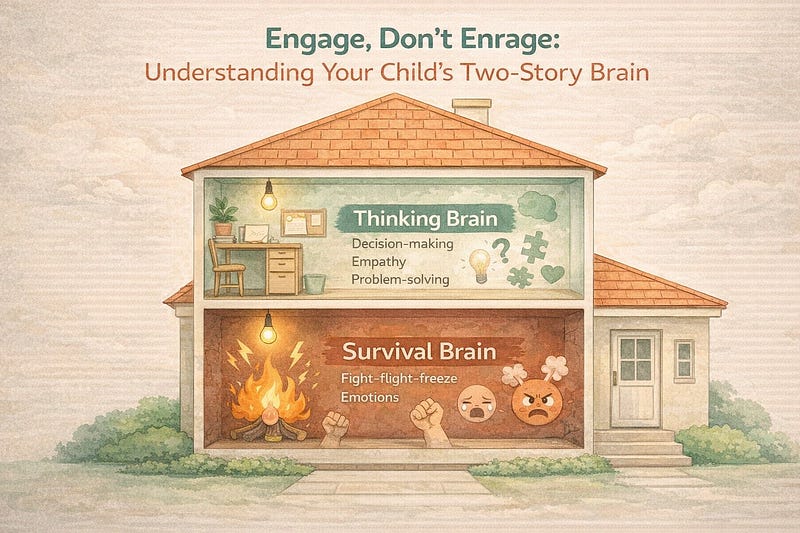
Think of your child’s brain like a two story house,
The Downstairs Brain (brainstem and limbic region) This is your child’s survival headquarters. It controls,
- Basic functions like breathing and body temperature
- Fight-flight-freeze reactions
- Strong emotions like fear and anger
- Instinctive responses
The downstairs brain is fully developed at birth. It’s primitive, powerful, and FAST. When your child feels threatened, physically OR emotionally and this is the part that takes over.
The Upstairs Brain (cerebral cortex) This is your child’s executive headquarters. It handles,
- Decision-making and planning
- Emotional regulation
- Empathy and understanding consequences
- Problem-solving and thinking ahead
- Self-awareness
Here is the catch: The upstairs brain doesn’t fully develop until the mid-twenties.
Yes, you read that right. That’s why teenagers make impulsive decisions. That’s why your 8-year-old can’t “just calm down and think.” Their upstairs brain is literally still under construction.
· · ·
What Happens When We “Enrage” Instead of “Engage”

Picture this now: Your child’s downstairs brain is already activated. Maybe they’re frustrated, scared, or overwhelmed. The upstairs brain is the thinking, reasoning part and now is starting to go offline.
And then we, as parents, do something that feels logical to us but neurologically shuts everything down:
- We threaten: “If you don’t stop right now, you’re grounded!”
- We demand: “I don’t want to hear it. Just do what I said.”
- We lecture: “How many times do I have to tell you the same thing?”
- We dismiss: “You’re overreacting. It’s not that big a deal.”
In our minds, we’re trying to enforce boundaries. To teach discipline. To make them snap out of it.
But here is what’s actually happening in their brain:
Their downstairs brain perceives US as a threat. Their fight-flight-freeze response gets STRONGER. The upstairs brain is the part that could help them think, reflect, and learn, goes completely offline.
No learning happens. No problem-solving happens. No emotional regulation happens.
They are in pure survival mode now.
· · ·
The Alternative: Engage the Upstairs Brain

Dan Siegel and Tina Payne Bryson are clear about this: “Engage, Don’t Enrage” isn’t about permissive parenting. It’s not about negotiating everything or never saying no.
It’s about recognizing when your child’s upstairs brain is still accessible—and using that window to help them THINK instead of just REACT.
Here is the shift:
Instead of trying to control the behavior with threats or demands, we invite the upstairs brain back online by asking questions, offering choices, and involving them in problem-solving.
Not because we’re soft. Because it actually WORKS.
· · ·
What This Looks Like in Real Life
Let’s revisit those earlier scenarios but this time, with the upstairs brain in mind.
Scenario 1: The Morning Shoe Battle
Enraging approach: “If you don’t put on your shoes RIGHT NOW, no TV for a week!”
What’s happening: You’re activating their fight-flight-freeze response. Their downstairs brain digs in harder. Now it’s a power struggle.
Engaging approach: “I can see you’re not ready yet. Help me figure this out that what can we do so we are not late?”
What’s happening: You are activating their upstairs brain. Problem-solving. Decision-making. You are still setting a boundary (we can’t be late), but you are involving them in the solution.
· · ·
Scenario 2: The Forgotten Assignment
Enraging approach: “This is unacceptable! You are so irresponsible. You are losing your phone until you can prove you care about your grades.”
What’s happening: Shame triggers the downstairs brain. They shut down or get defensive. No actual learning about responsibility happens.
Engaging approach: “I can see this assignment slipped through. What happened? Let’s figure out what we can do now, and what system might help you remember next time.”
What’s happening: You are acknowledging the mistake without shame. You are engaging their upstairs brain to reflect, problem-solve, and think ahead and the exact skills they need to develop.
· · ·
Scenario 3: The Sibling Fight
Enraging approach: “I don’t care who started it! Both of you, go to your rooms. I don’t want to hear another word.”
What’s happening: You are demanding compliance, but you are not teaching conflict resolution, empathy, or emotional regulation.
Engaging approach: “Okay, I can see you both are really upset. Let’s take a breath. Tell me what happened from your side. Then I want to hear your sister’s side. And then we will figure out what to do.”
What’s happening: You are slowing things down. You are engaging their upstairs brain to reflect on perspective-taking, cause-and-effect, and fairness.
· · ·
When the Downstairs Brain Has Already Taken Over
Sometimes, your child is already past the point of reasoning. They are mid-meltdown. Fully downstairs.
In those moments, engaging the upstairs brain isn’t an option yet.
First, you need to do what we learned in Strategy #1: Connect emotionally. Stay calm. Offer comfort. Let the storm pass.
THEN once they’ve regulated now you can engage the upstairs brain: “That was really hard, wasn’t it? Let’s talk about what happened. What do you think we could do differently next time?”
This is when real learning happens. When the body is calm, the upstairs brain can come back online and reflect.
· · ·
A Story from the Forest

During one of our BECOMING retreats, the one for teenagers, we had a 16-year-old girl who seemed to be holding everything together. Quiet, polite, doing all the activities without complaint.
On the third day, we took the group into the forest for a “forest bathing” experience. It’s a slow, sensory practice, walking barefoot, noticing textures, sounds, silence.
About twenty minutes in, she started crying.
Not soft tears. Deep, chest-shaking sobs.
One of the facilitators immediately went to her. Not with “What’s wrong?” or “You’re okay” but with presence. Sitting beside her. Breathing with her.
After a few minutes, the facilitator asked softly: “Do you want to tell me what’s coming up?”
The girl nodded. And over the next half hour, she shared something she’d never told anyone, that she’d been feeling completely numb for months. Disconnected from herself. Going through the motions but feeling nothing.
The forest, the silence, the permission to just BE, it had opened something in her that had been locked away.
Here’s what the facilitator did NOT do:
- Rush her out of the feeling (“It’s okay, don’t cry”)
- Fix it with advice (“Have you tried talking to someone?”)
- Minimize it (“Everyone feels like this sometimes”)
Instead, she stayed. She witnessed. She let the girl’s body release what it needed to release.
And then when the tears slowed and the breathing steadied she asked:
“What do you think your body was trying to tell you?”
That’s engaging the upstairs brain. Not in the middle of the storm but after. When there’s space to reflect, to make meaning, to integrate.
The girl later told us: “I didn’t know I was allowed to feel this much.”
· · ·
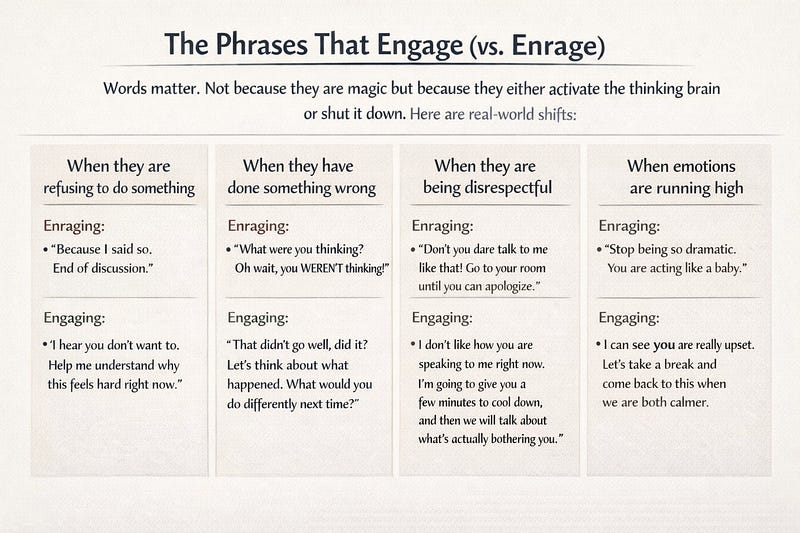
The Phrases That Engage (vs. Enrage)
Words matter. Not because they are magic but because they either activate the thinking brain or shut it down.
Here are real-world shifts,
When they are refusing to do something
Enraging: “Because I said so. End of discussion.”
Engaging: “I hear you don’t want to. Help me understand why this feels hard right now.”
· · ·
When they have done something wrong
Enraging: “What were you thinking? Oh wait you WEREN’T thinking!”
Engaging: “That didn’t go well, did it? Let’s think about what happened. What would you do differently next time?”
· · ·
When they are being disrespectful
Enraging: “Don’t you dare talk to me like that! Go to your room until you can apologize.”
Engaging: “I don’t like how you are speaking to me right now. I’m going to give you a few minutes to cool down, and then we will talk about what’s actually bothering you.”
· · ·
When emotions are running high
Enraging: “Stop being so dramatic. You are acting like a baby.”
Engaging: “I can see you are really upset. Let’s take a break and come back to this when we both are calmer.”
· · ·
What About Boundaries? What About Discipline?
I can already hear the question forming: “So if I’m not supposed to threaten consequences or demand compliance, how do I actually discipline my child?”
This is important. Engage, Don’t Enrage is NOT permissive parenting.
Boundaries still matter. Consequences still matter. Structure still matters.
The difference is HOW we enforce them.
Here’s the principle:
Connect first. Engage their thinking brain. THEN set the boundary.
Example:
Your 10-year-old hits their younger sibling during an argument.
Permissive approach: “I understand you were frustrated, sweetie. It’s okay. Just try not to do it again.” (No boundary. No consequence. The child doesn’t learn.)
Enraging approach: “That’s it! You’re grounded for a month! I’ve told you a thousand times not to hit!” (Shames the child. Activates downstairs brain. No real learning happens.)
Engaging approach:
- Separate them. Make sure everyone is safe.
- Once calm: “That was not okay. Hitting is never allowed. I need you to understand why.”
- Engage their thinking: “How do you think your brother felt when you hit him? What could you have done instead?”
- Set the consequence: “You’re going to lose screen time today. And you’re going to apologize to your brother when you’re ready.”
- Problem-solve for next time: “Next time you feel that angry, what can you do BEFORE you hit?”
See the difference?
The boundary is clear. The consequence is real. But the LEARNING happens because you engaged their upstairs brain to think, reflect, and plan ahead.
· · ·
Building the Upstairs Brain Over Time
Here is the beautiful part. Every time you engage your child’s upstairs brain instead of triggering their downstairs brain, you are helping that upstairs brain get STRONGER.
Neural pathways are built through repetition. The more you invite your child to:
- Reflect on their choices
- Consider consequences
- Think through solutions
- Regulate their emotions
…the more their upstairs brain develops the capacity to do these things independently.
But if we constantly bypass their thinking brain with threats, demands, and shame and if we keep them stuck in reactive mode then those neural pathways don’t get built.
And then we wonder why our teenager still can’t seem to “think before they act.”
It’s not because they are lazy or defiant.
It’s because we’ve been training their downstairs brain to be in charge.
· · ·
When You are the One About to Lose It
Let’s be honest: Sometimes it’s OUR downstairs brain that’s running the show.
Your child pushes a button. You feel your chest tighten, your jaw clench. You know you are about to say something you’ll regret but you can feel it coming anyway.
In those moments, the kindest thing you can do for everyone is pause.
“I need a minute. I’m about to say something I don’t mean. Let me cool down, and then we’ll talk.”
Model what you are teaching.
Show your child that even adults need to re-engage their upstairs brain sometimes.
· · ·
The Long View
Parenting is not about controlling behavior in the moment.
It’s about building a brain that can regulate itself, solve problems, and make thoughtful decisions even when we are not there.
Every time we engage instead of enrage, we’re investing in that long-term development.
Not because it’s easy. Not because it always works perfectly.
But because it respects the reality of how the brain actually grows.
· · ·
This Works for Us Too
One more thing:
Your upstairs brain is still developing too. Not literally but experientially.
When you are stressed, overwhelmed, or triggered, YOUR downstairs brain can hijack your thinking.
You know this feeling:
- You snap at your partner over something small
- You catastrophize a situation that isn’t actually that serious
- You make a reactive decision you later regret
That’s your downstairs brain taking over.
So when you notice yourself getting flooded, heart racing, thoughts spiraling, Do pause.
Take a breath. Move your body. Step away if you need to.
Re-engage YOUR upstairs brain before you try to engage theirs.
We can’t teach what we don’t practice.
· · ·
In the next post, we move deeper into building that upstairs brain with Strategy #4: Use It or Lose It, where we will explore how giving children opportunities to practice decision-making, emotional regulation, and problem-solving actually strengthens the neural pathways they need.
If you’re following this series on WhatsApp, you will get it directly on Friday.
👉 Join the Young SoulTales Parent’s Circle We share these strategies, plus real stories from our camps and retreats, twice a week.
· · ·
Preeti Toraskar is the founder of Young SoulTales, offering experiential programs that help children develop emotional literacy through research-backed, body-based approaches. She is currently completing her Master’s in Expressive Movement Therapy and has trained with Dr. Daniel Siegel in developmental psychology. She lives in Pune with her teenage daughter.
· · ·
Strategy #2—Name It to Tame It: The Power of Storytelling → Next: Strategy #4 : Use It or Lose It (Coming Friday)
