

Whole-Brain Strategy #7: Remember to Remember
“How was your day?”
“Fine.”
“What did you do?”
“Nothing.”
Sound familiar?
Every parent knows this exchange. You pick them up from school, genuinely curious about their world, and you get… monosyllables. Or worse, the classic “I forgot.”
For years, I thought this was just a kid thing. Maybe even a preteen thing (Aarya has perfected the art of the one-word response).
But here’s what I’ve learned:
The problem isn’t that children don’t want to share. It’s that “how was your day?” is actually a terrible question.
Not because it’s unimportant. But because it asks their brain to do something incredibly difficult, compress eight hours of experiences into a single summary while being put on the spot.
Most adults couldn’t do that well either.
There’s a better way. And it doesn’t just improve dinner conversations but it literally shapes how your child’s brain develops.
· · ·
The Science of Memory (And Why It Matters More Than You Think)

In The Whole-Brain Child, Dr. Daniel Siegel and Dr. Tina Payne Bryson explain that memory isn’t a single thing, it’s actually two different systems working together.
Implicit Memory: This is the body’s memory. It stores emotions, sensations, and patterns without us consciously being aware. It’s why certain smells transport you back to childhood. Why your body tenses when you walk into a room where something bad once happened, even if you can’t consciously remember what.
Explicit Memory: This is the memory we’re aware of. It has two parts:
- Factual memory ~ dates, names, information
- Autobiographical memory ~ the story of our life, who we are, what happened to us
Here’s what matters for parents:
Children’s explicit memory especially autobiographical memory doesn’t develop automatically. It develops through recollection.
When we help children TALK about their experiences, we’re helping their brain move information from implicit storage (felt but not understood) to explicit storage (understood and integrated).
Without this process, experiences remain fragmented. The child feels things but can’t make sense of them. Over time, this creates what psychologists call an “incoherent narrative” means a sense of disconnection from their own story.
With this process, children develop what Dr. Siegel calls “mindsight” which means the ability to see their own mind, understand their experiences, and develop a clear sense of who they are.
This is why “Remember to Remember” is Strategy #7 in the whole-brain approach:
Make recollection a daily practice.
· · ·
The Question Behind the Question
When you ask “how was your day?” you’re actually asking your child to:
- Scan through eight hours of experiences
- Decide what’s important enough to mention
- Summarize it coherently
- Do all of this while possibly tired, hungry, or still processing
That’s a lot.
Compare that to: “What made you laugh today?”
Now the brain has a specific target. It’s not searching through everything, it’s looking for ONE thing with an emotional anchor.
Or: “Was there a moment today when you felt really proud of yourself?”
Or: “Did anything happen today that felt unfair?”
These specific questions do something powerful, they help the brain retrieve AND process at the same time.
· · ·
What Indian Homes Get Right (And What We Miss)
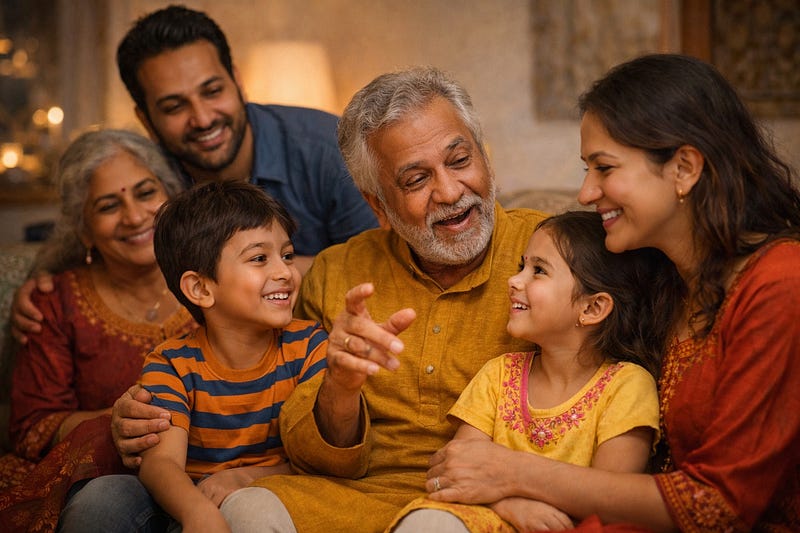
In many ways, Indian families already have pieces of this practice built into our culture.
Joint families meant children grew up hearing stories ~ about the day’s events, about family history, about their own birth and early years. Grandparents were natural memory-keepers. “Do you remember when you were three and you…” was a staple of family gatherings.
This repetitive storytelling wasn’t just entertainment. It was literally building children’s autobiographical memory, giving them a sense of where they came from and who they were.
But something has shifted.
In nuclear families, with busier schedules, with screens competing for attention at mealtimes, these organic recollection moments are disappearing.
We’ve also inherited a particular pattern around difficult memories:
“Why are you still thinking about that?”
“That happened so long ago.”
“Don’t dwell on negative things.”
We covered this in Blog #6 ~ the cultural tendency to push children to “forget” difficult experiences rather than process them.
But “Remember to Remember” isn’t just about difficult memories. It’s about ALL memories—the joyful ones, the ordinary ones, the confusing ones, the proud ones.
Every time we help a child recall and reflect on an experience, we’re helping their brain integrate it.
And integration is the foundation of emotional health.
· · ·
The Daily Practice: Making Recollection Normal
The Siegel-Bryson approach isn’t complicated. It’s about creating small, consistent rituals where recollection becomes natural.
Some families call it “Highs and Lows” ~ at dinner, everyone shares one high point and one low point from their day. Not just the child ~ the parents too. This normalizes both positive and difficult experiences, and models reflection.
Some families do “Rose, Thorn, Bud”:
- Rose: Something good that happened
- Thorn: Something challenging
- Bud: Something you’re looking forward to
Some families use bedtime as the recollection moment. Before sleep, a simple: “Tell me about one thing that happened today” followed by engaged listening.
The specifics matter less than the consistency.
When children know that every day there will be a moment to recall, share, and be heard, several things happen:
- They start paying attention differently during the day ~ knowing they’ll share later makes them more aware of their experiences
- They develop vocabulary for internal experiences ~ regular practice builds emotional articulation
- They feel known ~ being asked about their inner world, consistently, communicates: “Your experiences matter to me”
· · ·
Age-Specific Approaches
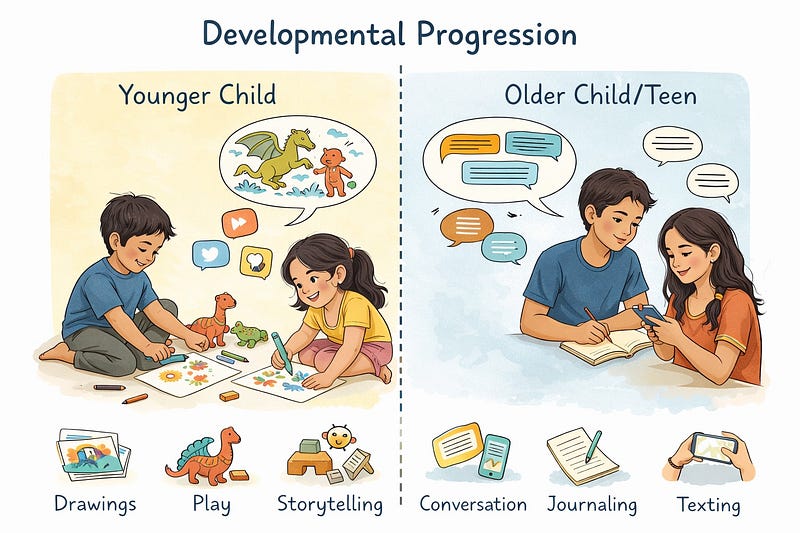
For Younger Children (Ages 5–9)
Young children often remember in fragments. They might recall a single vivid image but not the sequence of events. This is developmentally normal.
Help them by:
- Using photos or drawings: “Can you draw what happened at the birthday party?” The act of drawing helps the brain organize and retrieve memories.
- Telling THEIR stories back to them: “Remember when we went to Dadu’s house and you found that frog in the garden?” Children love hearing stories about themselves. And each retelling strengthens that memory.
- Being a curious audience: When they share something, ask follow-up questions. Not interrogating ~ just genuinely interested. “And then what happened? How did that feel?”
- Making it playful: Use puppets or stuffed animals to “act out” the day. “Can you show Bear what happened at school today?”
For Older Children (Ages 9–12)
Children this age have more developed narrative ability but may be less willing to share spontaneously. Peer relationships and self-consciousness are growing.
Help them by:
- Asking specific questions: Not “how was your day” but “what was the most interesting thing your teacher said today?” or “was there any drama in your friend group?”
- Sharing your own day first: Model vulnerability. “Something embarrassing happened to me today…” When parents share, children often follow.
- Using car time: Something about not making eye contact (both facing forward) often makes conversations flow more easily.
- Creating space for difficulty: “I noticed you seemed quiet after cricket practice. Anything happen?” Opening doors without forcing them through.
For Teenagers (Ages 13–17)
Teenagers may actively resist what feels like intrusion. Independence is developmentally appropriate. But they still need these conversations—perhaps more than ever.
Help them by:
- Timing it right: Not the moment they walk in the door. Give them transition time. Find natural windows.
- Texting: Some teens will text things they won’t say face-to-face. A simple “How’d it go?” text can open doors.
- Asking for their opinion/advice: “Something happened at work today and I’m not sure what to do. Can I tell you about it?” Teens often engage when positioned as trusted advisors rather than subjects of inquiry.
- Night-time conversations: Many parents report that teenagers open up most late at night. If you’re a night owl, stay available.
- Respecting privacy while staying present: They don’t have to share everything. But let them know you’re always interested when they’re ready.
With Aarya, now 14, I’ve learned that forcing conversation never works. But being consistently available and interested does. Some of our best conversations happen at 10 PM when I thought she was asleep and she appears in my room wanting to talk.
· · ·
What We Do at Young SoulTales Retreats
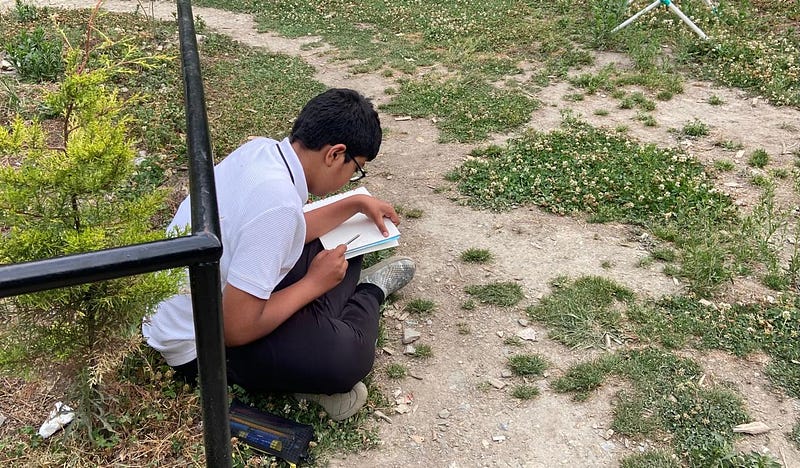
At our retreats, recollection isn’t an afterthought ~ it’s woven into every day.
Evening circles are a cornerstone of our camps. After a full day of activities, children gather to share. But we don’t ask “how was your day?”
We might ask:
- “What surprised you today?”
- “Was there a moment you felt scared and did it anyway?”
- “What did you notice about yourself today that you’d never noticed before?”
These questions invite depth. They also help children process and integrate the day’s experiences before sleep.
Morning circles often start with: “Did anyone have an interesting dream? Did anyone wake up thinking about something from yesterday?”
This teaches children that experiences don’t end when they happen but they continue to be processed by the brain. And that’s normal.
At our BECOMING retreats for teenagers, we use journaling alongside group sharing. Some teens prefer to write first, speak second. Some only write. Both are valid ways to practice recollection.
I remember one boy at a camp who was quiet all week during circle time. He barely spoke. On the last day, he asked if he could read something from his journal.
He read a full page about a moment on Day 2 when another child had helped him during a challenging activity. He’d been thinking about it all week. What it meant. Why it mattered. How he wanted to be that kind of person for someone else.
He’d been recollecting, integrating, making meaning ~ all internally.
The circle had given him permission and space. The consistency of the practice had shown him: your experiences and reflections matter here.
· · ·
Why This Matters for Identity
Here’s the deeper purpose of “Remember to Remember”:
We are our memories.
Not in a mystical sense but in a very practical, neurological sense. Our sense of self, our identity, our understanding of who we are and how we became this way ~ it all comes from autobiographical memory.
Children who regularly practice recollection develop stronger autobiographical memory. They can answer questions like:
- “What kind of person am I?”
- “What do I like? What do I dislike?”
- “How did I handle difficult things in the past?”
- “What are my patterns?”
This is what Dr. Siegel calls a “coherent narrative” means a clear story of who you are that integrates different experiences, emotions, and parts of yourself.
Research shows that children with coherent narratives have:
- Better emotional regulation
- Stronger sense of identity
- More resilience in facing challenges
- Better relationships
And here’s what’s remarkable: you can actively help your child develop this.
Every time you help them recall and reflect, you’re literally building the neural pathways of self-understanding.
· · ·
Starting Tonight
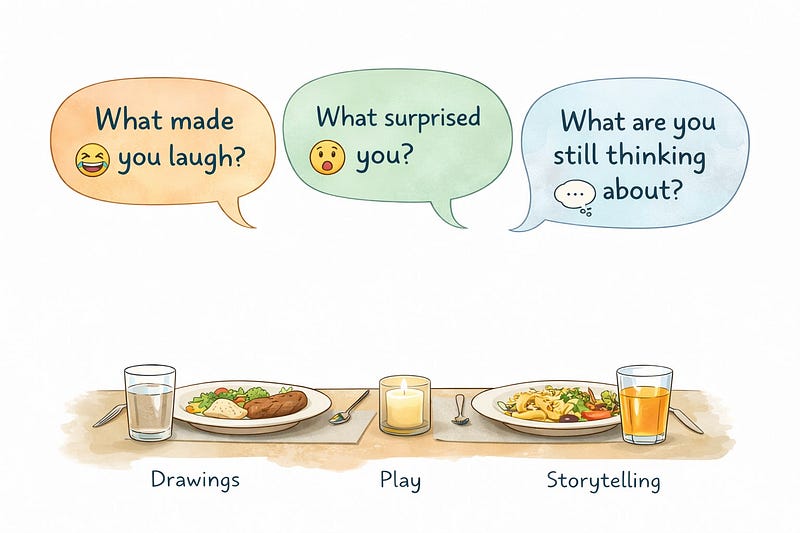
You don’t need to overhaul your routines. Start with one small practice:
Tonight at dinner (or bedtime), ask one specific question:
- “What was the most interesting thing that happened today?”
- “Was there a moment you felt proud of yourself?”
- “Did anything happen that you’re still thinking about?”
And then this is crucial~ really listen.
Not while looking at your phone. Not while planning what you’ll say next. Not while mentally making the grocery list.
Just listen. Ask follow-up questions. Be genuinely curious.
That’s it.
If you do this consistently ~ not perfectly, just consistently ~ you’ll start to notice something shift.
Your child will begin to tell you more. Not because you’re interrogating, but because they’ve learned that sharing is safe, valued, and normal in your family.
And you’ll be giving them something invaluable: a strong, clear sense of who they are.
· · ·
This Works for Us Too
Here’s something I’ve noticed about myself:
On days when I take even five minutes to reflect ~ what happened, how I felt, what it meant I sleep better. I feel more grounded. More like myself.
On days when I rush from one thing to the next without pausing to recollect, everything blurs together. Weeks pass and I can’t remember what I did. Time feels like it’s slipping away.
This strategy isn’t just for children. Adults need recollection too.
Many of us have lost the habit. We’re so busy doing that we never pause to remember and integrate what we’ve done.
Try this for yourself:
Before bed, take two minutes to mentally review your day. Not to judge it or plan tomorrow but just to recall. What happened? What did you feel? What surprised you?
You might find, like I did, that this small practice creates a strange sense of… coherence. Of being present in your own life instead of just rushing through it.
And when your child sees you valuing reflection ~ when you share your own “high and low” at dinner, when you say “something interesting happened to me today” you’re modeling that recollection matters.
You’re not just teaching a strategy. You’re showing them what it looks like to pay attention to your own life.
· · ·
What’s Next
In the next post, we’ll move into the second half of the book: Building the “Memory” Brain. We’ll explore Strategy #8: Increase the Family Fun Factor and discover why positive shared experiences are essential for emotional resilience and connection.
If you’re following this series on WhatsApp, you’ll get it directly on Tuesday.
👉 Join the Young SoulTales Parent’s Circle ~ We share these strategies, real stories from our camps, and tools for helping children process and integrate their experiences.
· · ·
Preeti Toraskar is the founder of Young SoulTales, where children’s emotional development is the curriculum. She’s currently completing her Master’s in Expressive Movement Therapy, has trained with Dr. Daniel Siegel, and is the mother of a 14-year-old who still (sometimes) tells her about her day ~ usually at 10 PM when everyone should be asleep.
· · ·
← Previous: Strategy #6 ~ Use the Remote of the Mind: Replaying Memories Safely → Next: Strategy #8 ~ Let the Clouds of Emotion Roll By (Coming Friday)
