

Whole-Brain Strategy #5: Move It or Lose It
Your child is having a meltdown.
You say: “Go to your room and calm down.”
Or: “Sit here until you can control yourself.”
Or: “Stop running around and FOCUS.”
Here’s the problem:
You just asked their dysregulated nervous system to do the one thing it literally cannot do.
Sitting still doesn’t calm the brain. Movement does.
This isn’t about willpower or discipline. This is about neurobiology.
When your child’s emotions are running high, when they’re anxious, angry, overwhelmed, or overstimulated their body is flooded with stress chemicals. Their nervous system is in fight-or-flight mode.
And the fastest way to reset that system? Not through talking. Not through sitting. Not through “trying harder to calm down.”
But Through movement.
· · ·
The Brain-Body Connection We Keep Forgetting
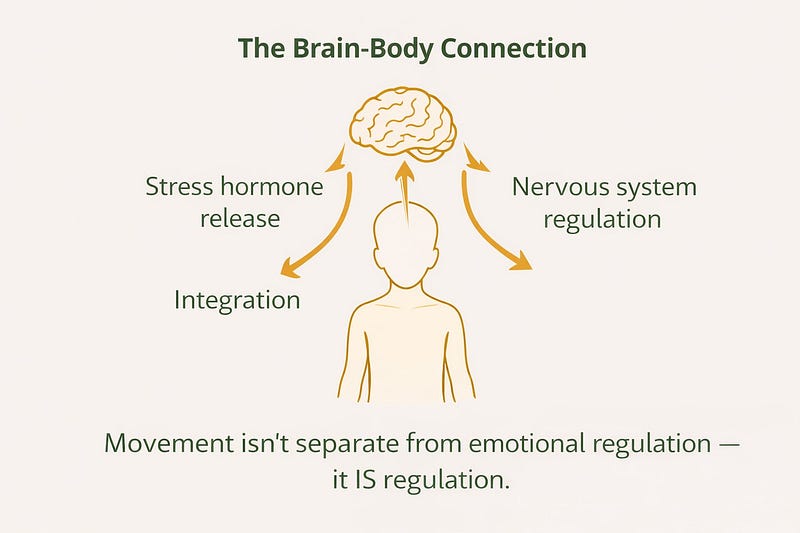
We treat the brain like it’s separate from the body.
We think: “You need to calm your mind. So sit down and think it through.”
But the brain doesn’t work that way.
The brain is deeply interconnected with the body. In fact, one of the fastest pathways to regulating the emotional brain (the downstairs brain we talked about in Strategy #3) is through the body.
Here’s what happens when your child moves:
1. Stress hormones get metabolised Cortisol and adrenaline, the chemicals flooding their system during emotional overwhelm are literally burned off through physical movement. The body processes them faster when it’s active.
2. The nervous system downregulates Rhythmic, repetitive movement (like walking, swinging, or bouncing) activates the parasympathetic nervous system, the “rest and digest” mode that counteracts fight-or-flight.
3. Both sides of the brain integrate Cross-lateral movement (using opposite sides of the body, like crawling or dancing) forces the left and right hemispheres of the brain to communicate. This is exactly what we need for emotional regulation.
4. Feel-good chemicals are released Movement triggers endorphins and dopamine, natural mood regulators that help the brain shift out of distress and into balance.
Movement isn’t just good for physical health.
It’s essential for emotional and neurological health.
· · ·
The “Sit Still and Focus” Culture
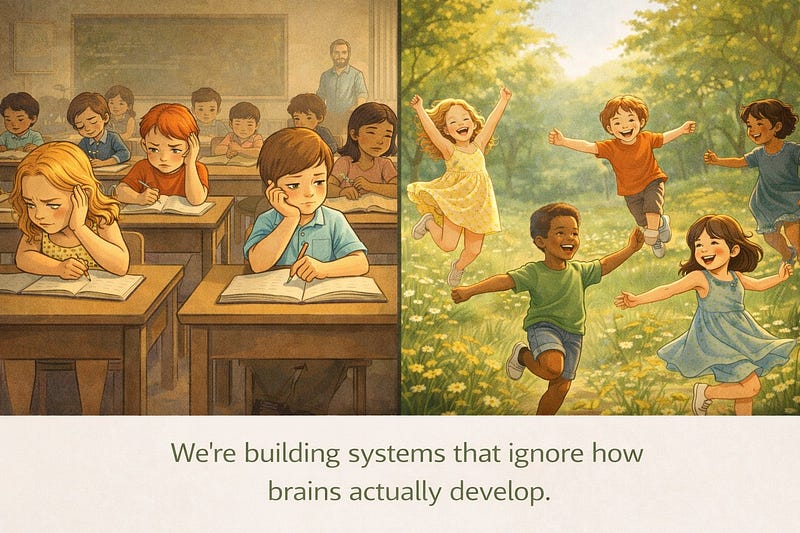
Let’s talk about what we’re actually asking of our children.
In Indian schools (and many schools worldwide), we demand:
- Sit at a desk for 6–8 hours
- Stay quiet and still
- Focus on abstract concepts
- Control your body and emotions
- Don’t fidget, don’t wiggle, don’t move
And then we’re surprised when kids can’t regulate their emotions, can’t focus, and seem perpetually restless or “difficult.”
But here’s what neuroscience shows:
Children’s brains are not designed to sit still for long periods.
Their nervous systems are wired for movement. In fact, movement is how young brains LEARN. It’s how they process information, release stress, and integrate experiences.
When we force children to be sedentary for hours on end, we’re not teaching them discipline.
We’re dysregulating their nervous systems.
And then when they finally explode, when the pent-up energy and stress can’t be contained anymore then we label them:
- “Hyperactive”
- “Unfocused”
- “Difficult”
- “Out of control”
But what if they’re not the problem?
What if the problem is that we’ve built systems that ignore how brains actually work?
· · ·
The Irony: We’re Asking Dysregulated Kids to Sit Still
Think about the last time YOU were stressed or upset.
Maybe you paced. Maybe you went for a walk. Maybe you cleaned the house or went to the gym or did yoga.
You instinctively knew: I need to move to feel better.
But when our children are stressed or upset, we tell them to do the opposite:
“Sit down and think about what you did.” “Go to your room until you calm down.” “Stop fidgeting and pay attention.”
We’re asking their dysregulated nervous systems to regulate through stillness.
It doesn’t work.
Not because they’re defiant. Because it’s neurologically impossible.
Movement isn’t a distraction from emotional regulation. Movement IS emotional regulation.
· · ·
The Different Types of Movement (And Why They Matter)
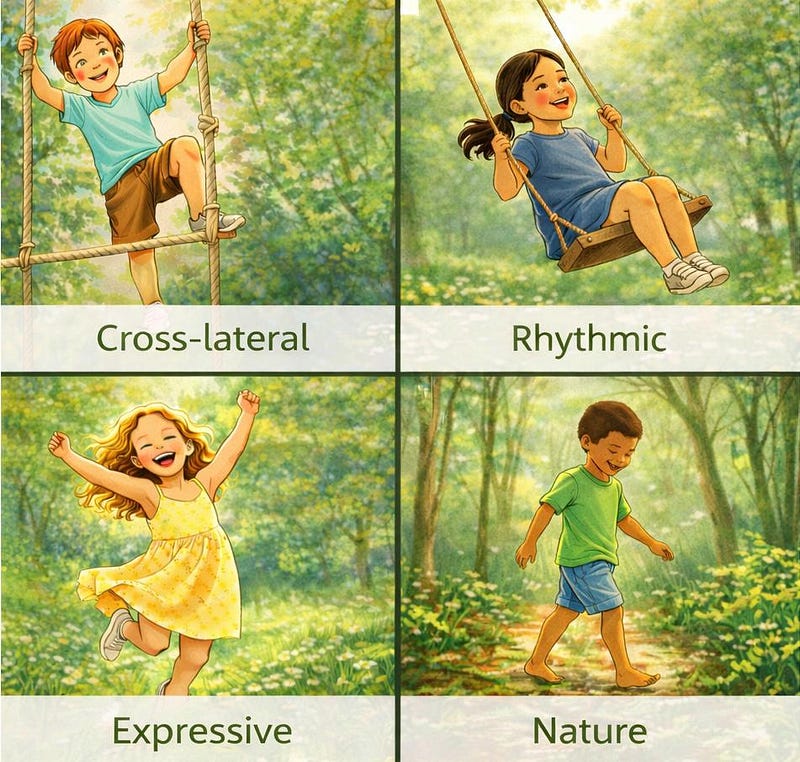
Not all movement is created equal when it comes to brain integration and emotional regulation.
Here are the types that matter most:
1. Cross-Lateral Movement (Left-Right Brain Integration)
This is movement that crosses the midline of the body where the left side and right side have to coordinate.
Examples:
- Crawling (yes, even for older kids)
- Marching with opposite arm and leg
- Dancing that involves crossing arms or legs
- Swimming
- Climbing
- Juggling
Why it works: Cross-lateral movement forces the left and right hemispheres of the brain to communicate. Remember Strategy #1 (Connect and Redirect)? We talked about integrating the logical left brain with the emotional right brain. Cross-lateral movement is one of the fastest ways to make that happen physically.
When to use it: When your child is stuck in rigid thinking, emotional overwhelm, or can’t seem to “snap out of” a mood.
· · ·
2. Rhythmic, Repetitive Movement (Nervous System Regulation)
This is movement that has a steady, predictable rhythm.
Examples:
- Swinging
- Rocking
- Walking (especially in nature)
- Jumping on a trampoline
- Drumming
- Dancing to a steady beat
Why it works: Rhythmic movement activates the parasympathetic nervous system, the body’s natural “calm down” mechanism. It’s deeply soothing to the nervous system, which is why babies instinctively respond to rocking and why we pace when we’re anxious.
When to use it: When your child is anxious, overstimulated, or having trouble winding down.
· · ·
3. Free Expression Movement (Emotional Release)
This is unstructured movement where the body gets to express what words can’t.
Examples:
- Free dance (no choreography, just moving)
- Shaking out the body
- Jumping or stomping
- Expressive movement to music
- Wild, silly movement (animal walks, freeze dance)
Why it works: Emotions are stored in the body. Sometimes the fastest way to process them is to let the body MOVE them through. This isn’t about “working out” but it’s about giving emotions a physical outlet.
When to use it: When your child has big feelings they can’t articulate, or when they seem to have pent-up energy that’s making them irritable or explosive.
· · ·
4. Outdoor/Nature Movement (Grounding and Integration)
This is movement in natural settings and not on a treadmill or in a gym, but outside.
Examples:
- Walking barefoot on grass or sand
- Hiking
- Playing in a park or forest
- Climbing trees
- Running on uneven terrain
Why it works: Nature provides sensory input that screens can’t replicate, variable terrain, natural light, fresh air, sounds, textures. The combination of movement + nature is particularly powerful for calming the nervous system and resetting attention.
When to use it: When your child is overwhelmed by screens, academic pressure, or overstimulation. Or honestly, just daily as a baseline practice.
· · ·
A Story from the Forest (Again)

At our camps, we don’t start with talking circles or reflective exercises.
We start with movement.
On the first morning of one of our BECOMING retreats, the group of teenagers arrived visibly tense. They didn’t know each other. They were self-conscious. Some had their arms crossed.
We could have started with introductions and icebreakers.
Instead, we took them straight into the forest for a “wake-up walk.”
No agenda. No structure. Just: “Walk. Notice what you notice. Move at whatever pace feels right.”
Some walked fast. Some walked slowly. Some climbed rocks. One girl took off her shoes and walked barefoot.
After 20 minutes, the energy had completely shifted.
Bodies were looser. Faces were softer. A few kids were laughing.
One facilitator later told me: “You could see their nervous systems settling. They weren’t trying to be ‘cool’ anymore. They were just… present.”
That’s what movement does.
It bypasses the social anxiety, the self-consciousness, the mental chatter.
It brings you back into your body. And when you’re in your body, your brain can integrate.
Later in the retreat, we introduced movement where kids could dance, shake, stomp, or move however their body wanted to move. No judgment. No “right way.”
One quiet, reserved girl, who barely spoke the first day, suddenly came alive. She started moving with this wild, joyful abandon. Arms flailing. Jumping. Fully unselfconscious.
Afterward, she said: “I didn’t know I was allowed to move like that.”
That’s the gift we’re robbing our children of when we tell them to sit still, stay quiet, and control themselves.
We’re teaching them to ignore their body’s wisdom.
· · ·
But My Child is Too Energetic / Hyperactive
I hear this all the time from parents:
“My child is already so hyperactive. If I let them move MORE, they’ll be completely out of control.”
Here’s the reframe:
High energy is not a problem to be controlled. It’s a resource to be channeled.
Children with naturally high energy levels have nervous systems that NEED more sensory input and movement to regulate. When we try to suppress that energy by making them sit still, we’re actually making it worse.
Think of it like a pressure cooker. If you keep the lid on too tight for too long, eventually it explodes.
But if you release the pressure regularly through intentional, structured movement the system stays regulated.
High-energy kids don’t need LESS movement. They need MORE movement. And they need it more frequently.
Instead of:
- “Stop running around and sit down!”
Try:
- “I can see your body needs to move. Let’s do 20 jumping jacks together, and then we’ll sit for homework.”
Instead of:
- “Why can’t you just focus?”
Try:
- “Let’s take a movement break every 20 minutes. What kind of movement feels good to your body right now?”
You’re not reinforcing “bad behavior.”
You’re giving their nervous system what it actually needs to regulate.
· · ·
Quick Movement Interventions (For When You Need Them NOW)
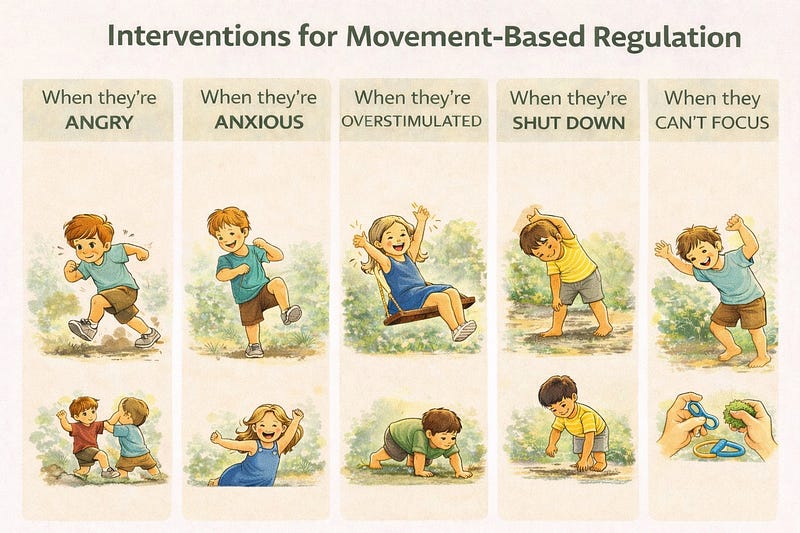
Here are simple, fast movement strategies you can use in the moment when your child is dysregulated:
When they’re ANGRY:
✦ Stomp it out: “Let’s stomp around the room like angry elephants for 60 seconds. As loud as you can.” ✦ Push against a wall: Have them push against a wall with both hands as hard as they can for 10 seconds, 3 times. ✦ Rip paper: Give them old newspapers or magazines to rip into shreds.
Why it works: Anger needs a physical outlet. These give the energy somewhere to go.
· · ·
When they’re ANXIOUS or OVERWHELMED:
✦ Cross-crawl: Have them march in place, touching opposite hand to opposite knee. 1 minute. ✦ Slow swinging: If you have a swing, 5–10 minutes of gentle, rhythmic swinging. ✦ Walk and breathe: Walk together outside, matching breath to steps (inhale for 4 steps, exhale for 4 steps).
Why it works: Rhythmic movement + cross-lateral activation calms the nervous system and integrates the brain.
· · ·
When they’re OVERSTIMULATED or “wound up”:
✦ Shake it out: Stand and shake the whole body arms, legs, head for 30 seconds. Then freeze. Repeat 3 times. ✦ Animal walks: Crab walk, bear crawl, frog jumps across the room. ✦ Dance party: Put on one high-energy song and dance wildly. Then one slow, calming song.
Why it works: Releases excess energy, then transitions the nervous system back to calm.
· · ·
When they’re SHUT DOWN or withdrawn:
✦ Gentle stretching: Simple stretches while taking deep breaths. ✦ Walk barefoot outside: Even just 5 minutes on grass or sand. ✦ Bilateral tapping: Tap alternating hands on thighs or shoulders in a steady rhythm.
Why it works: Gentle movement can “wake up” a shut-down nervous system without overwhelming it.
· · ·
When they CAN’T FOCUS (homework, etc.):
✦ Movement breaks every 20 minutes: Set a timer. When it goes off, 2 minutes of jumping jacks, running in place, or dancing. ✦ Fidget tools while working: Let them squeeze a stress ball, bounce on an exercise ball, or use a fidget spinner while reading/working. ✦ Walk-and-talk: If they’re struggling with a concept, go for a walk while discussing it.
Why it works: The brain focuses better AFTER movement. Fighting their need to move is making focus harder, not easier.
· · ·
The Screen Problem: Sedentary AND Dysregulated
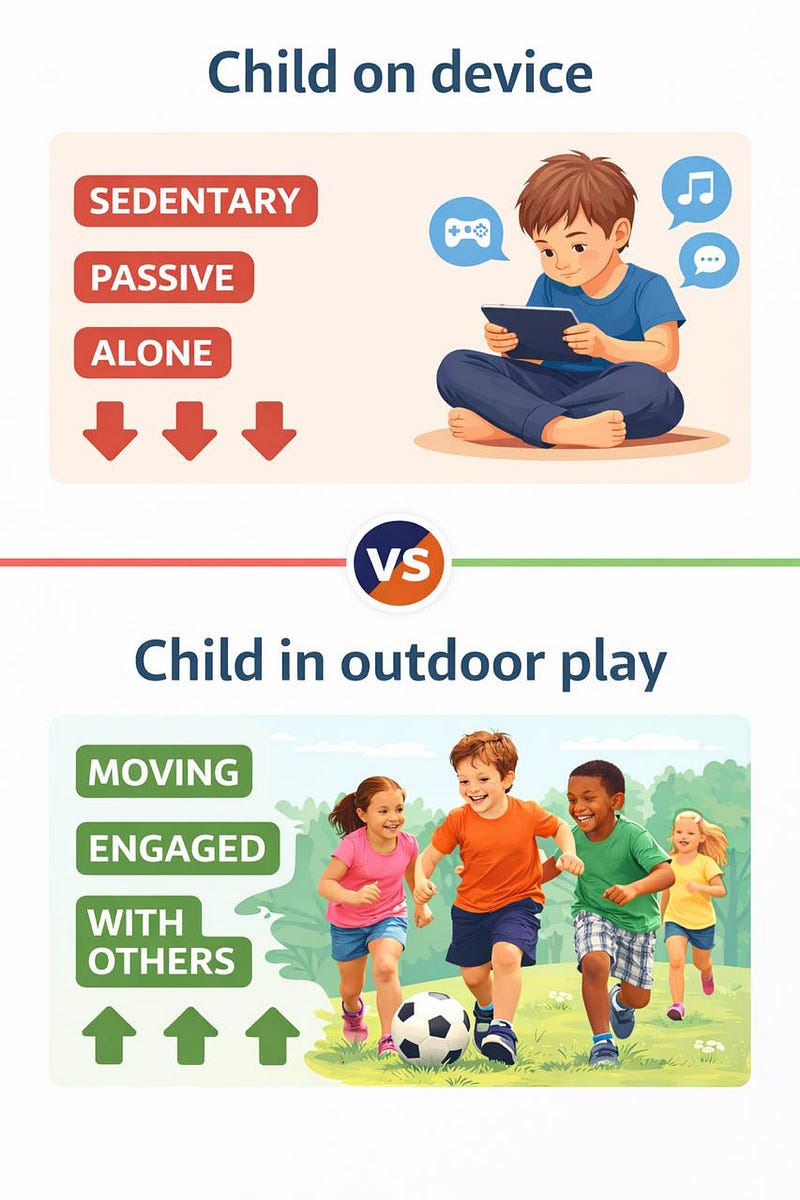
We need to talk about screens.
Because screens are creating a perfect storm for dysregulation:
1. They keep kids sedentary Hours of sitting without movement = no stress hormone release, no nervous system regulation, no brain integration.
2. They overstimulate the nervous system The rapid visual input, constant notifications, and emotional intensity (especially social media) keep the nervous system in a low-grade fight-or-flight state.
3. They replace outdoor play Kids used to spend hours outside moving, climbing, running, exploring. Now they’re inside, still, staring at screens.
4. They hijack the reward system The dopamine hits from screens are addictive. Real-world movement (which also releases dopamine) can’t compete.
The result?
Kids who are simultaneously:
- Physically lethargic (sedentary lifestyle)
- Emotionally dysregulated (overstimulated nervous system)
- Chronically anxious or irritable (no healthy outlet for stress)
- Unable to focus (no movement breaks to reset attention)
And then we wonder why mental health issues are skyrocketing.
Screens aren’t just taking away movement time. They’re replacing the very activities that would help kids regulate.
I’m not saying ban screens entirely. But I am saying:
Movement needs to be non-negotiable. Daily. Multiple times a day.
Not as a reward. Not as “exercise.” But as a basic neurological need like sleep or food.
If your child is getting 2+ hours of screen time per day but less than 30 minutes of movement, their nervous system is paying the price.
· · ·
Movement as a Daily Practice (Not an Afterthought)
Here’s the shift we need to make:
Stop thinking of movement as something kids do AFTER they’ve finished their “real work” (school, homework, chores).
Start thinking of movement as the foundation that makes everything else possible.
Movement isn’t the reward for good behavior or completed tasks.
Movement is what ENABLES good behavior, focus, emotional regulation, and learning.
Here’s what this looks like practically:
Morning: 10–15 minutes of movement before school (dance, yoga, outdoor walk, play)
After school: 30+ minutes of active play or outdoor time BEFORE homework
During homework: Movement breaks every 20–30 minutes
Evening: Gentle, rhythmic movement to help transition to calm (slow walk, stretching, rocking)
Weekend: At least 2 hours of unstructured outdoor play
This isn’t “extra.” This is baseline.
This is what a developing brain needs to stay regulated, focused, and emotionally healthy.
· · ·
What This Looks Like at Young SoulTales
Movement isn’t something we add to our programs.
Movement is woven into everything we do.
We don’t start days with lectures. We start with body-based activities like walking, dancing, expressive movement, nature immersion.
We don’t ask kids to “sit still and share their feelings.” We create experiences where the body processes what the mind can’t articulate yet.
We use:
- Forest bathing (slow, sensory-based walking in nature)
- Expressive movement (free dance where emotions can be released physically)
- Group movement activities (where kids have to coordinate, cooperate, and problem-solve while moving)
- Grounding practices (barefoot walking, feeling textures, connecting to earth)
Because we know:
The body remembers what the mind forgets.
Children don’t always have words for what they’re feeling. But their bodies know.
And when we give them permission to MOVE freely, wildly, gently, whatever they need the integration happens.
Not through talking about feelings.
Through feeling them IN the body. And letting the body release them.
· · ·
This Works for Us Too
One last thing:
Adults need this too.
When you’re stressed, anxious, or overwhelmed, don’t just sit there trying to “think your way” through it.
Move.
Take a walk. Dance in your kitchen. Do jumping jacks. Shake out your body.
Your nervous system will regulate faster than it ever could through stillness.
And your children are watching.
If they see you using movement to regulate YOUR emotions, they’ll learn that movement isn’t just “exercise” it’s a tool for life.
Model what you’re teaching.
· · ·
What’s Next
In the next post, we’ll explore Strategy #6: Use the Remote of the Mind—where we learn how to help children “rewind and reframe” difficult experiences so their brains can integrate them instead of getting stuck in loops of fear or shame.
If you’re following this series on WhatsApp, you’ll get it directly on Friday.
👉 Join the Young SoulTales Parent’s Circle—We share these strategies, movement practices, and tools for helping children develop emotional and physical regulation.
· · ·
Preeti Toraskar is the founder of Young SoulTales, offering experiential programs rooted in body-based, movement-centered approaches to emotional literacy. She is currently completing her Master’s in Expressive Movement Therapy and has trained with Dr. Daniel Siegel in Putting Personalities into Practices. Her work is grounded in the belief that the body is not separate from the mind, it’s the fastest pathway to integration and healing.
· · ·
Previous: Strategy #4—Use It or Lose It: Why Your Child’s Brain Needs Practice → Next: Strategy #6—Use the Remote of the Mind (Coming Friday)
